
A child’s room that lasts is a room designed to grow.
Few projects tempt people more to go all in on the theme of the moment. Superheroes, princesses, jungle animals: lovely at first, exhausting to manage three years later when tastes have changed. The real question before painting and decorating is the same as for any other space: how do you create something that lasts, adapts, and stays beautiful over time? The rules that apply to combining colors in interior design apply here too, with a few adjustments specific to children.
Choose a wall color that will last
The first criterion for a child’s room color is timelessness. Colors strongly tied to a trend, a theme, or a fashion fade fast. Soft tonal ranges, such as blue, green, pale yellow, or pastel or deep pink, are calming, adaptable, and age well with the child.
Sea green is one of Clara AJMAR’s favorite colors for this use. It suits girls and boys alike, pairs easily with pale wood, white, or black, and looks just as elegant at 10 years old as at 3.
Strong colors work better in touches
Strong colors such as red or deep blue work better as accents than on every wall. An intense color on all four walls of a child’s room can quickly become heavy and hard to live with over time, for the child and for the parents who spend time there too. One colored wall, a few objects, a curtain, or a piece of furniture in the chosen shade give the same impact without committing to a complete repaint six months later. To explore shades and pairings further, the different shades of green in interior design show how one color family can produce very different moods.
Pick a shade from the wallpaper
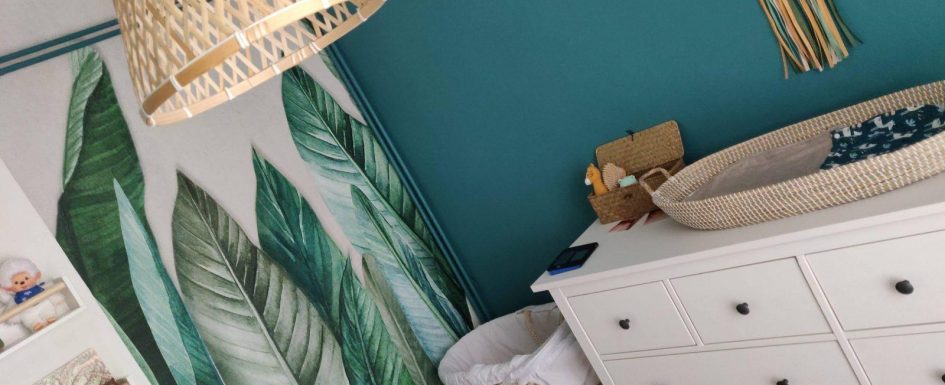
We followed this principle in another child’s room, pairing a deep blue-green paint with a panoramic wallpaper of large tropical leaves. The botanical decor brings movement, and the plain paint on the adjacent wall extends its palette. White furniture, natural-fiber accessories, and a woven pendant keep the room light despite the scale of the pattern. Rather than adding unrelated colors, repeat one shade from the wallpaper on a neighboring wall: the room feels personal without being overloaded.
Professional tip: choose a neutral, timeless color as the base and bring in character through easily replaceable elements: bedding, curtains, posters, cushions. When the child moves on to a new world, you change the accessories, not the walls. It is the most economical and the smartest approach in the long run.

Organize storage on three heights
Storage in a child’s room has to serve two very different users: the child and the parent. Clara’s rule on projects is to divide storage into three height zones.
The low zone, within the child’s reach, holds what they use on their own every day: everyday toys, books, small storage bins. It is the zone of their independence, accessible without help.
The middle zone, reachable by parents and by a slightly older child, holds everyday items that need some supervision: clothes, school bag, school supplies.
The high zone, out of the child’s reach, is for storage and seasonal items: next year’s clothes, toys put aside for later, spare things.
This three-level organization prevents accidents and destructive rummaging while encouraging the child’s independence in their own space.
From the field: on child’s-room projects with custom furniture, Clara generally places the most-used bins and drawers between 40 and 80 cm (about 16 to 32 in) from the floor, the range where a young child can reach easily without losing balance. Above about 120 cm (47 in), you enter the parent zone. These are benchmarks, not fixed dimensions: they adjust to the child’s age and height and change as the child grows. It is simple to respect on a plan and genuinely changes daily habits in the room.
Build it to take the knocks
A few criteria matter when building these three zones. Low drawers should open effortlessly and safely: full-extension runners with a stop so a drawer cannot fall out, and handles without sharp edges or finger-pull openings. A carcass in plywood or good-quality board with well-bonded edging withstands knocks better than entry-level particleboard. Every tall piece of furniture must be fixed to the wall with hardware suited to the wall type, even if it looks stable. For the first years, our article on the convertible nursery explains how to choose the crib and the dresser.
See our projects in video
Real floor plans and renovations explained step by step on the ArchiWorking YouTube channel. Watch how spaces are reworked before the works begin.
Washable paint and practical tips for parents
Washable paint is a must in a child’s room. It is not a question of style but of daily survival. Handprints, markers left on the wall, toys bumped against it: all of this happens, and a non-washable paint does not forgive.
A good-quality acrylic paint in satin or eggshell cleans easily with a damp cloth and withstands repeated rubbing, provided it is labeled washable: an eggshell finish is not necessarily washable. Check the technical data sheet, in particular the scrub-resistance class. The source cites the European standard NF EN 13300, from class 1, the most resistant, to class 5. Also prefer a paint with low indoor-air emissions; in France, the A+ label indicates the lowest level.
Keep a can in reserve
The tip Clara gives parents every time: keep a can of paint in reserve with the exact color reference. Not to repaint everything, but for spot touch-ups. A small damaged area can be fixed in ten minutes if you have the right color at hand. Without it, you are condemned to redo the whole wall or live with the mark.
Paint the baseboards separately
Baseboards deserve special attention in a child’s room. Painting them white, separately from the walls, makes later touch-ups easier and stands up better to the knocks and scuffs that inevitably happen at floor level, where play and learning are at their most energetic. Any interior designer includes this technical detail in a child’s room to make parents’ lives easier over the years.
Real projects: deep green, soft blue, and pale wood
Deep green on two full walls
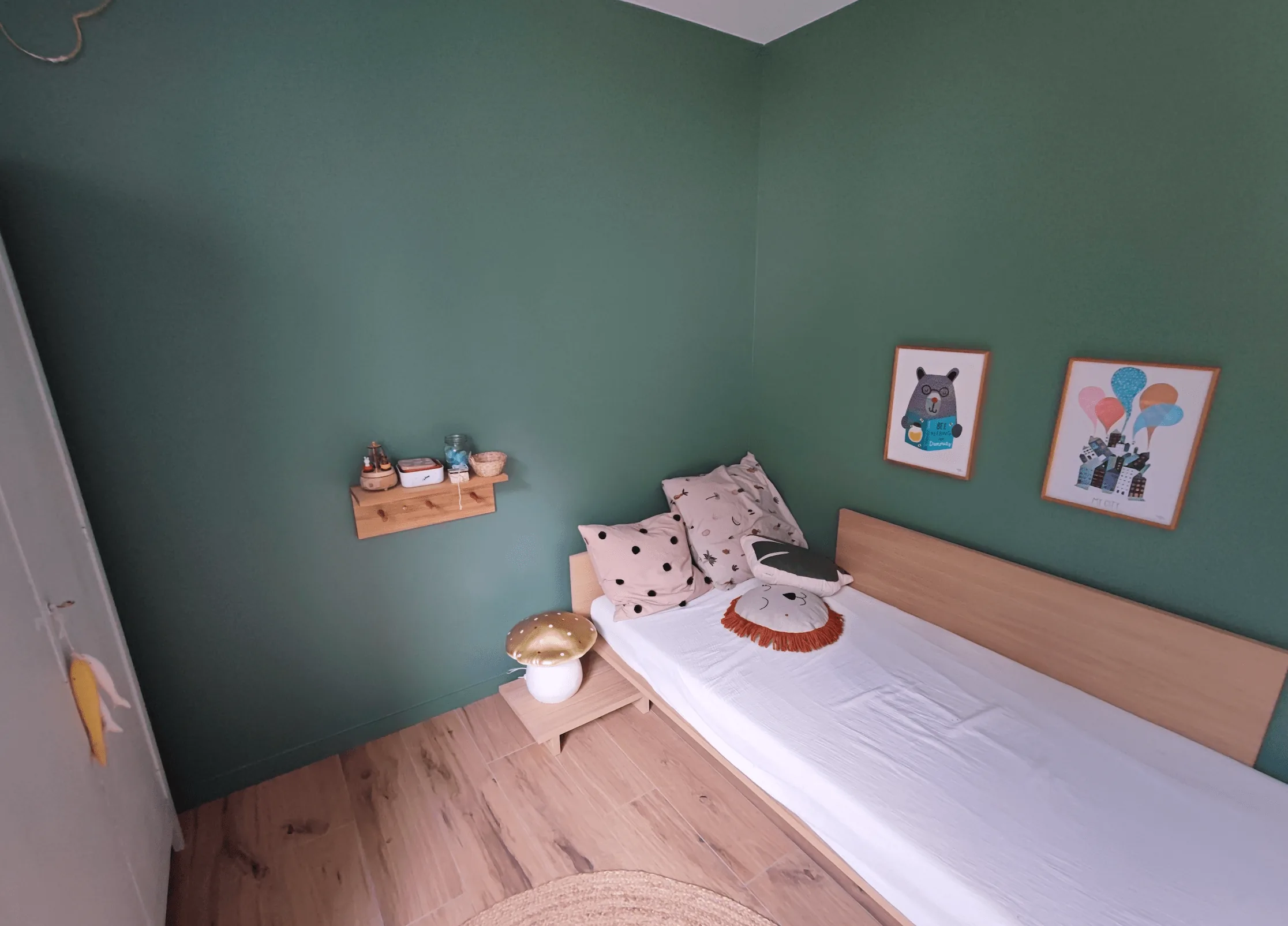
In a child’s room in a family apartment, we applied a deep green over the full height of two adjacent walls and kept the ceiling white for a clean contrast. The pale wood single bed, small wall shelves, and wood-effect floor bring warm materials that balance this strong color. The decor is deliberately minimal: two framed illustrations, a small shelf for everyday objects, and light textiles. The paint carries the whole composition, with no complex furniture. A strong color can envelop a child’s room, as long as it is balanced by materials, light, and a few pale surfaces.
Green, wood, and natural fibers for a newborn
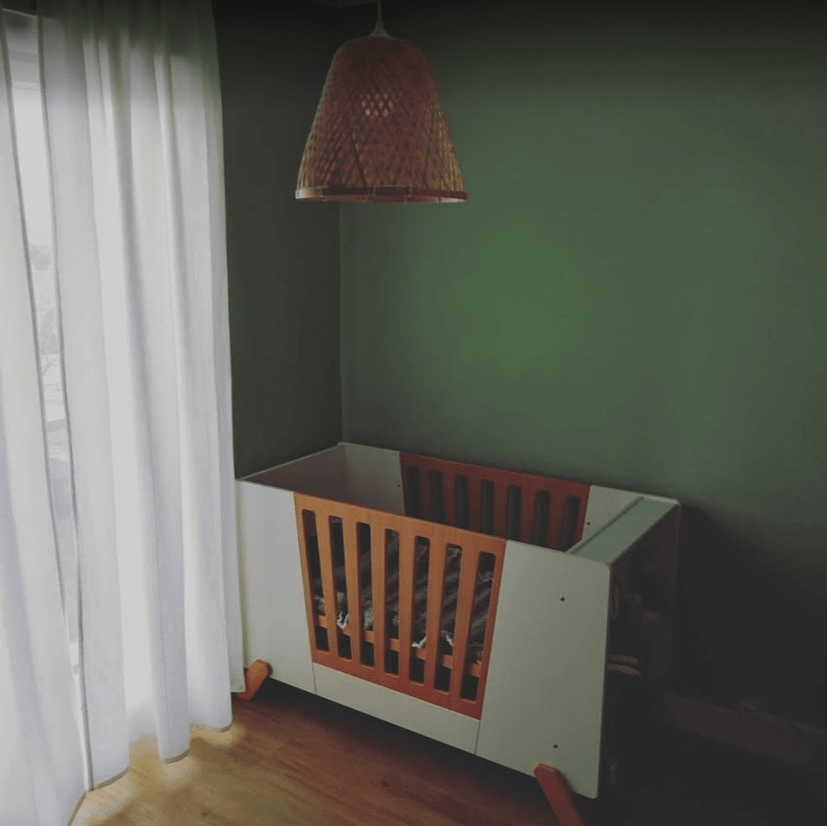
In a newborn’s room, we paired green with wood and natural fibers. A two-tone wooden crib, a woven pendant, and full-height white curtains make up the essentials, completed by a wood-effect floor and white baseboards. The green forms a uniform background behind the crib, and the natural materials vary the textures without adding color. A nursery does not have to be pastel: a deeper shade works with simple furniture, light textiles, and warm materials.
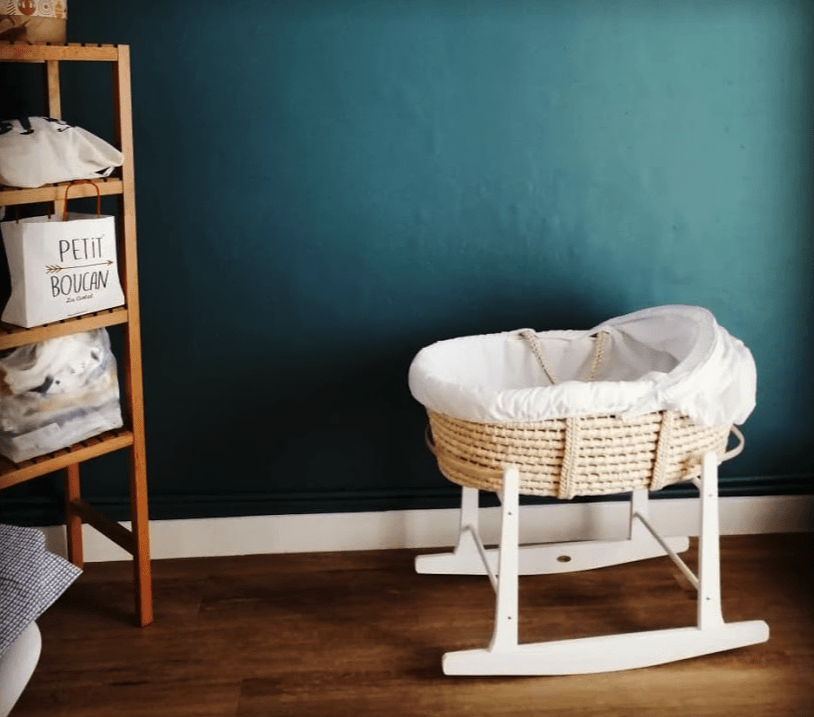
For safety, keep the baby’s sleeping space clear: no loose fabrics, canopies, or cords within reach of the crib. Decorative textiles belong elsewhere in the room, as in the mood image of the soft blue-gray nursery shown here.
A room that grows with the child
A successful child’s room is not the one that looks most like what the child wants today. It is the one that gives them a space suited to their needs, neutral enough to evolve with them, and organized well enough that parents and child can both find their way around easily. Our articles on the princess bedroom and the animal-themed room apply this logic to two themes children often ask for: a lasting base, a decor that can change. More real projects are on the ArchiWorking YouTube channel, linked in the box above.
Frequently asked questions about color in a child’s room
Which color will last in a child’s room?
Soft tonal ranges, such as blue, sea green, pale yellow, or pastel or deep pink, are the most timeless. They adapt to changing tastes and age well with the child. Strong colors work better as accents on one wall or on easily replaceable accessories.
Which paint should you use in a child’s room?
A washable acrylic paint in satin or eggshell withstands rubbing and cleans easily. Always keep a can in reserve with the exact reference for touch-ups. Baseboards painted white separately also make spot repairs easier without repainting the whole wall.
How should storage be organized in a child’s room?
In three height zones: a low zone within the child’s reach for everyday toys and books, a middle zone for everyday items with parental supervision, and a high zone for seasonal storage. This encourages independence while limiting accidents.
Should the room reflect the child’s taste or stay neutral?
The two are compatible. Choose a neutral, timeless base for the walls and furniture, and let the child express current tastes through easily replaceable accessories: bedding, posters, cushions, curtains. When today’s heroes go out of fashion, you change the accessories without touching the walls.
Is an eggshell paint always washable?
No. “Eggshell” describes the look of the finish, not its resistance to cleaning. Check the scrub-resistance class on the data sheet (NF EN 13300, from 1, the most resistant, to 5) and the indoor-air emissions label, ideally the lowest level for a child’s room.