
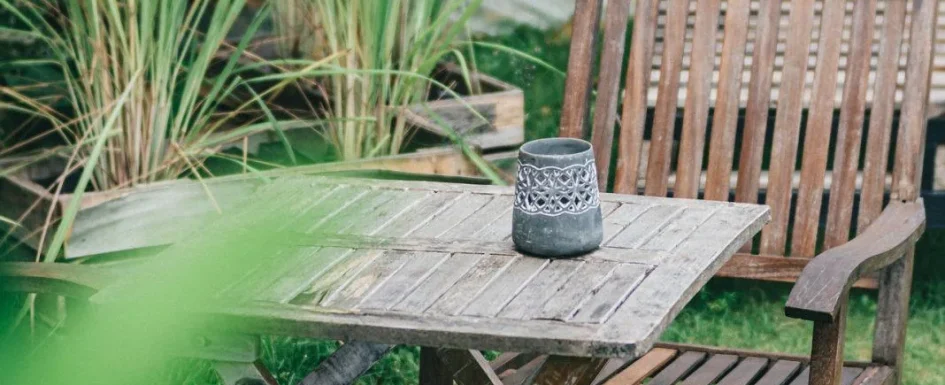
A minimalist Mediterranean garden is not an empty garden. It uses fewer elements, chosen carefully: water-conscious planting, natural materials, a readable plan, useful shade and soil that suits the plants.
The atmosphere comes from a balance between restraint and life. Too many ornaments make the space difficult to read; too little planting can leave a harsh mineral setting that is uncomfortable in the sun. The aim is an elegant outdoor place that belongs to the house and can actually be used.
Our xeriscaping guide develops the water-saving method behind many of these decisions. Mediterranean style, a dry garden and xeriscaping overlap, but they describe different things: a landscape character, an emphasis on low water use, and a design approach respectively.
Start with comfort and the existing site
Decide where people will eat, sit, move, maintain planting and reach the terrace or pool. Then consider the views from the house. A bench can be visually perfect yet remain unused if it faces the strongest sun without protection.
Minimalism should make these uses clearer, not remove them. A defined dining area, a quiet corner and simple routes often contribute more than a collection of small decorative objects.
Look at what is already valuable. Existing trees, stone terraces and established vegetation can provide the scale and character that new work would take years to recreate. A restrained garden does not require a cleared site.
Soil and exposure before the plant list
Ground disturbed by pool or terrace work may be compacted, altered or depleted. Many Mediterranean plants tolerate dry conditions but are much less forgiving of water around their roots in winter. Drainage deserves attention before planting.
Assess compaction, clay, fertility and how water actually leaves the planting area. A suitable amendment may help a poor soil, but the objective is a root environment matched to the plants, not a decorative surface concealing an unsuitable base.
The original guidance discusses a wide planting hole, gravel or volcanic aggregate and slightly raised planting on clay. These are not a universal drainage recipe. An amended hole within impermeable clay can still retain water; assess the whole planting zone and drainage route before choosing a method.
South-facing exposure often suits a Mediterranean palette, but walls, fences, buildings and trees create microclimates. A shaded corner may stay cooler and wetter than the open terrace. Different parts of one garden can therefore require different choices.
Our practical ground and renovation articles offer further context. Soil, exposure and local constraints should be understood before buying plants.
A sloping garden with existing stone terraces
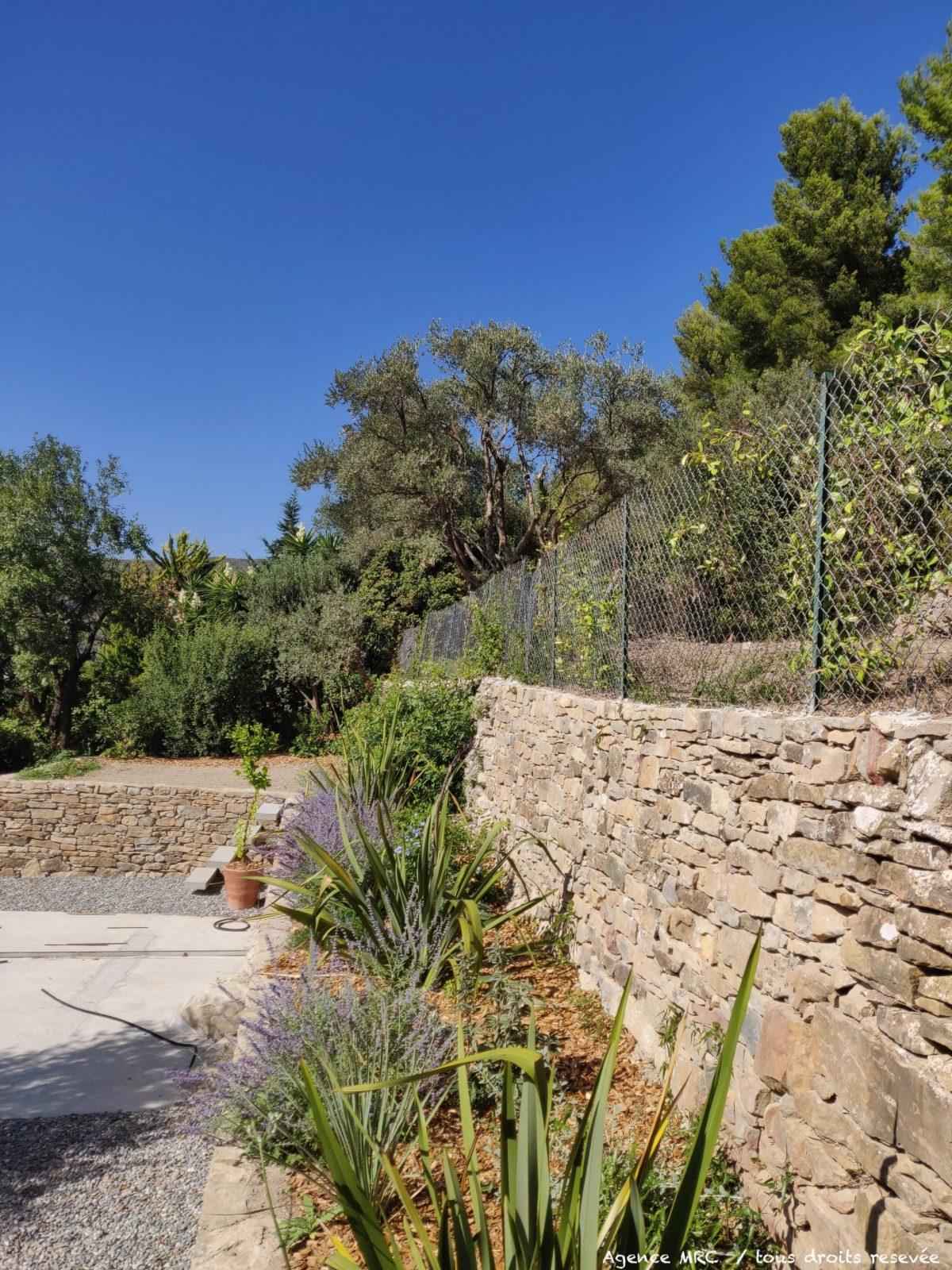
In one hillside-house project, we worked with existing dry-stone terraces rather than replacing their character with an entirely new flat composition. The goal was to make the levels easier to use while retaining their mineral identity and useful vegetation.
The work included adjusting levels, widening some terraces and creating masonry steps. Existing olives were combined with upright Italian cypresses, lavender, gaura, rosemary and climbing plants, alongside fruit trees.
Automatic irrigation helped establish new planting. The planting was organized according to levels, exposure and water needs rather than treated as a scattered collection of specimens.
A dry-stone retaining wall can allow water to pass through its structure. A masonry retaining wall needs a properly designed drainage arrangement, including suitable weep outlets where required; holes alone should not be assumed to solve every structural or groundwater issue.
The small pond and sloping-garden example develops the relationship between water and terraced land. Preserving useful trees and limiting materials can be more coherent than replacing planting with gravel.
Use repeated groups, not a plant collection
Olives, lavender, rosemary, rockrose, santolina, euphorbia, agave, sages, grasses and aromatic plants can contribute to the character. Check the actual species or cultivar against climate, soil and exposure rather than assuming every Mediterranean-looking plant is suitable.
The strength comes from repeated associations and contrasting textures. A limited number of well-placed varieties can have more impact than many isolated plants, while still creating layers and a living setting.
Cold hardiness is particularly important. Some agaves, olives and sages suffer during prolonged frost depending on variety and region. Drought tolerance does not imply unlimited winter hardiness.
Also check local invasive-species restrictions before selecting the exact plant. A familiar Mediterranean genus is not a guarantee that every species is ecologically appropriate or legal to introduce.
A useful trio: rosemary, Russian sage and gaura
Rosemary provides darker evergreen structure and an aromatic presence. Russian sage, commonly called perovskia, adds a lighter blue-toned vertical effect. Gaura contributes airy flowers and movement that soften the stricter lines.
Together they illustrate structure, color and flexibility without multiplying varieties. Once established in suitable, well-drained conditions, this association can be relatively undemanding and tolerant of dry conditions.
It is an example of roles, not a mandatory formula. If one plant does not suit the site, preserve the intended balance of persistent structure, lighter verticality and movement through locally appropriate selection.
Planting season and establishment watering
For the Mediterranean conditions described, autumn planting from September to November can let roots develop during milder, wetter weather before the first summer. The right dates still depend on the region and actual conditions, not the calendar alone.
Group plants by water demand. Keep the driest palette, such as rosemary, lavender and rockrose, separate from areas receiving more frequent irrigation; higher-demand planting may be placed nearer the terrace. New plants still need suitable establishment care.
The guidance favors deep, spaced watering over a little water every day during the first two summers, with once a week given as an example. That is not a fixed schedule for every soil or climate. Adjust to weather, drainage, root development and any local restrictions.
See our projects in video
Real floor plans and renovations explained step by step on the ArchiWorking YouTube channel. Watch how spaces are reworked before the works begin.
Natural materials and a softer mineral palette
Stone, unfinished-looking timber, terracotta, limestone gravel and pale render can connect garden, terrace, facade and landscape. Stone gives visual stability; terracotta adds warmth; timber softens the constructed lines.
Choose related tones such as limestone, sand, pale ochre, stone beige, terracotta, soft brown and warm gray. The point is not to make everything identical, but to avoid unrelated materials competing for attention.
Mineral mulch can organize beds, but its exposure and color matter. A large sunlit area should be assessed as a place to occupy, not just an image of a bright surface.
Suitable local limestone or travertine may be considered for barefoot areas, subject to the actual finish, slip performance and heat exposure. For terracotta paving in a cold-winter location, verify frost resistance rather than relying on its Mediterranean appearance.
Gravel size, depth and the hidden base
The planning references give angular gravel sizes of 6 to 10 mm or 10 to 14 mm, with a surface layer around 4 to 5 cm. Angular material generally moves less underfoot than rounded pebbles, but the right specification depends on the route and intended use.
For a path, the supporting compacted base and edging help prevent migration into planting beds. The attractive top layer is not the whole construction.
For mulch, the source gives around 5 to 8 cm of gravel, volcanic aggregate or wood chips as a reference to reduce evaporation and unwanted growth. Match material and depth to the plants and soil; do not bury crowns or treat every mulch as interchangeable.
Avoid impermeable plastic as a default under planting. Where an underlayer is appropriate, a permeable product may be considered, or the mulch may be used without fabric. The decision should preserve soil function rather than simply hide it.
Avoid pure-white glare without making a false heat rule
Immaculate white gravel or very pale marble pebbles can look elegant in an inspiration photograph. In strong sun, reflected light may become uncomfortable and increase exposure around nearby foliage.
That is a question of glare and reflected radiation, not a claim that white always absorbs more heat than darker material. Surface temperature depends on material, color and exposure; a pale surface can still be uncomfortable to look at or stand beside.
Limestone, cream, sand and pale ochre often give a softer visual result. Combine that choice with planting and shade instead of expecting color alone to solve thermal comfort.
The aim is a luminous garden rather than an aggressive one. Generous planted masses also prevent a restrained palette from becoming an empty mineral field.
Plan shade for today as well as later
A suitable deciduous tree can provide summer protection while admitting more winter sun. The source examples include plane-leaved mulberry, hackberry and linden, always subject to local suitability.
A new tree may need several years before it shades a terrace. In the meantime, a timber or metal pergola with fabric, reed screening or a planted trellis can provide more immediate shelter.
Place shade over the actual dining or seating area. A movable screen or sail toward the west can help with lower late-day sun. A shade sail needs sound anchoring and an appropriate slope so rainwater does not simply collect in it.
Position seating with regard to orientation, views, wind, access to the house and shade. The outdoor-living-space guide and contemporary garden article develop those relationships.
French boundary rules are context, not US law
The original projects are French. Check the local planning framework, including the PLU where relevant, before work affecting fences, walls, terrain, pools or regulated planting. Local rules or established local practices may affect the planting arrangement.
Where the French default rules apply, a planting exceeding 2 m in height generally requires 2 m from the neighboring boundary; planting at 2 m or below generally requires 50 cm. The official French planting guidance explains scope and exceptions.
Do not treat those figures as US setback rules. Confirm the actual property boundary and requirements for the site. An olive or cypress planted too close may later create a pruning or removal dispute; checking before planting is easier than resolving it afterward.
Connect the pool with the garden
A pool should relate to its deck, coping, walls, planting, shade, routes and views from the house. Soft mineral tones, suitable stone or timber and restrained edges can keep it within the overall composition.
Choose a surface suitable for wet barefoot use. Travertine or some limestones may be options, but no stone name guarantees that a surface will remain cool or non-slippery in every condition.
Keep plants with heavy leaf or flower fall away from the immediate edge where practical. Place agaves and other spiny plants away from barefoot routes, and keep lavender, rosemary and grasses back from chlorinated splash exposure.
Our pool and garden articles continue that transition. The accompanying pool-project video considers location, ground, structure, services, safety and landscape integration. Style does not remove any of those technical checks.
For a smaller water feature, the garden pond guide offers another scale of landscape integration.
Final questions before planting
What prevents an overly mineral result?
Keep planted masses, layers and movement. Preserve useful existing vegetation, avoid excessively large gravel fields and make shade part of the initial plan.
Which plants should lead?
Choose for the site first. Rosemary, gaura, Russian sage, lavender, santolina, rockrose and grasses illustrate a restrained palette; agaves and olives require their own suitability checks.
When is planting most effective?
The autumn September-to-November reference suits the Mediterranean conditions discussed, with regional adjustment. Establishment watering remains important during the first two summers even for a drought-conscious design.
Can a minimalist garden include a pool?
Yes, if water, routes, deck, planting, safety and shade form one composition. The pool should not become an isolated object surrounded by unrelated leftover spaces.
What completes the design?
A chosen atmosphere, limited materials, comfortable tones, suitable plants, prepared soil, useful shade, practical routes and checked local rules. Restraint requires more precision, not less attention to everyday life.
How should gravel and planting work together?
Use the mineral surface to support the planted composition, not replace it. A path needs a suitable base and edging as well as its selected gravel. A mulched bed has a different role, with depth and material matched to the soil and plants. Preserving soil function and avoiding excess reflected light are part of the decision, not separate concerns after installation.
How do the material colors affect comfort?
Cream, sand, limestone and pale ochre can provide a softer visual setting than an immaculate white field. They still need shade and planted areas. A restrained palette is successful when people can comfortably occupy it, not simply when all the samples look related.
What needs checking around an existing stone terrace?
Understand the retained levels, how water leaves the site, the condition and role of the walls, and how stairs connect the usable areas. Then organize planting for the different exposures. The hillside example retains character while improving use, rather than applying one flat-garden formula to every level.