
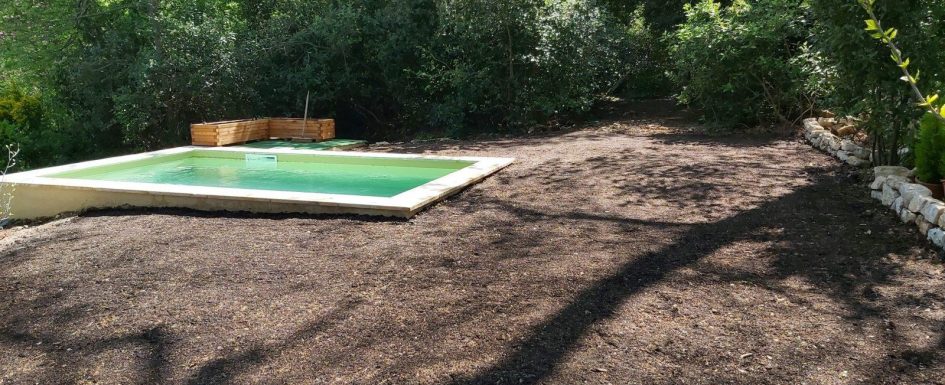
A small garden pond should be designed as part of the landscape, not treated as a container of water with stones added around it. Position, proportions, waterproofing, maintenance, wildlife, services and safety need to belong to the same plan.
First decide what the water is for: a reflection seen from the terrace, a planted wildlife refuge, a clear ornamental feature or a more technical arrangement. That choice changes depth, location and equipment.
Our outdoor and garden guides develop the wider composition. A pond should feel connected with the place rather than added after every other decision.
Begin with use, views and access
A pond can catch light, create reflections and provide a calmer focus even at modest scale. Its value depends on where it can be seen and how it relates to everyday routes.
Near a terrace, it may be enjoyed frequently. In a quieter corner, it can create a discovery. Along a path, it can accompany movement. None of those positions is automatically best without considering the actual garden.
Avoid placing it thoughtlessly beneath deciduous trees, where leaves increase the organic load and cleaning. Strong uninterrupted sun can also make algae management harder if planting and water balance are not considered.
Keep practical access to any pump, filter, inspection chamber and the surrounding edges. A feature that is attractive from the house but impossible to maintain comfortably will become a constraint.
Proportions and depth are planning references, not guarantees
The source describes small ornamental ponds around 2 to 6 m². It suggests a peripheral shelf around 20 to 30 cm deep for suitable marginal planting and a deeper zone around 60 to 80 cm or more.
Those depths can help moderate temperature in the temperate conditions discussed, but do not guarantee frost-free water in every US climate. Fish requirements depend on species, volume and local conditions; a depth number alone does not establish suitability.
A gently sloping edge or appropriately designed pebble beach can help birds drink and wildlife such as amphibians or hedgehogs escape. That wildlife access is a different question from child protection and must not be confused with it.
A video about the checks before excavation
The accompanying 5-minute 51-second video follows Clara’s checks for an outdoor water project: site, soil, dimensions, planning, safety, filtration, technical space and surrounding landscape.
The ten checks before a pool project gives the wider framework. Swimming pools and ornamental ponds share some questions, but not necessarily their treatment, intended use or legal requirements.
Use the video to understand the order of investigation rather than assuming every pool detail transfers directly to a wildlife pond.
Make the edges belong to the garden
Natural stone, suitable facing brick, mineral coping and marginal planting can create a transition between water and land while screening appropriate technical elements.
Look at materials already present in the terrace, walls, facade, steps, dry-stone terraces or stepping stones. Stone can age convincingly; suitable brick can create a warmer, more constructed character in a courtyard or urban garden.
Scale matters. Oversized blocks can overwhelm a small feature, while an excessively thin or mechanically regular border can emphasize its artificial appearance. Texture, proportion and planting soften the join.
Facing material is not the waterproof structure. Decide what retains the water before choosing what makes the edge attractive.
Shell, liner or masonry?
A preformed polyethylene or polyester shell can simplify installation, but fixes the shape and dimensions. It still needs a suitable base and properly supported installation.
A suitable EPDM liner, around 1 mm in the source example, provides flexibility and UV resistance. Its actual durability relative to PVC depends on grade, protection and installation; do not assume every liner of one material performs identically.
Protect the selected liner with suitable substantial geotextile against stones and roots, following its instructions. Confirm compatibility with the intended aquatic use rather than substituting an unrelated membrane.
For initial sizing, the source adds twice the depth to the length, then an edge allowance of 30 to 50 cm on each side. Repeat for width. Use the necessary maximum depth and full edge detail, not the average depth used in a volume calculation.
A masonry basin with an appropriate waterproof render or membrane allows straight edges and stone coping. Its structure needs proper design, especially where a slope creates uneven ground and water pressures.
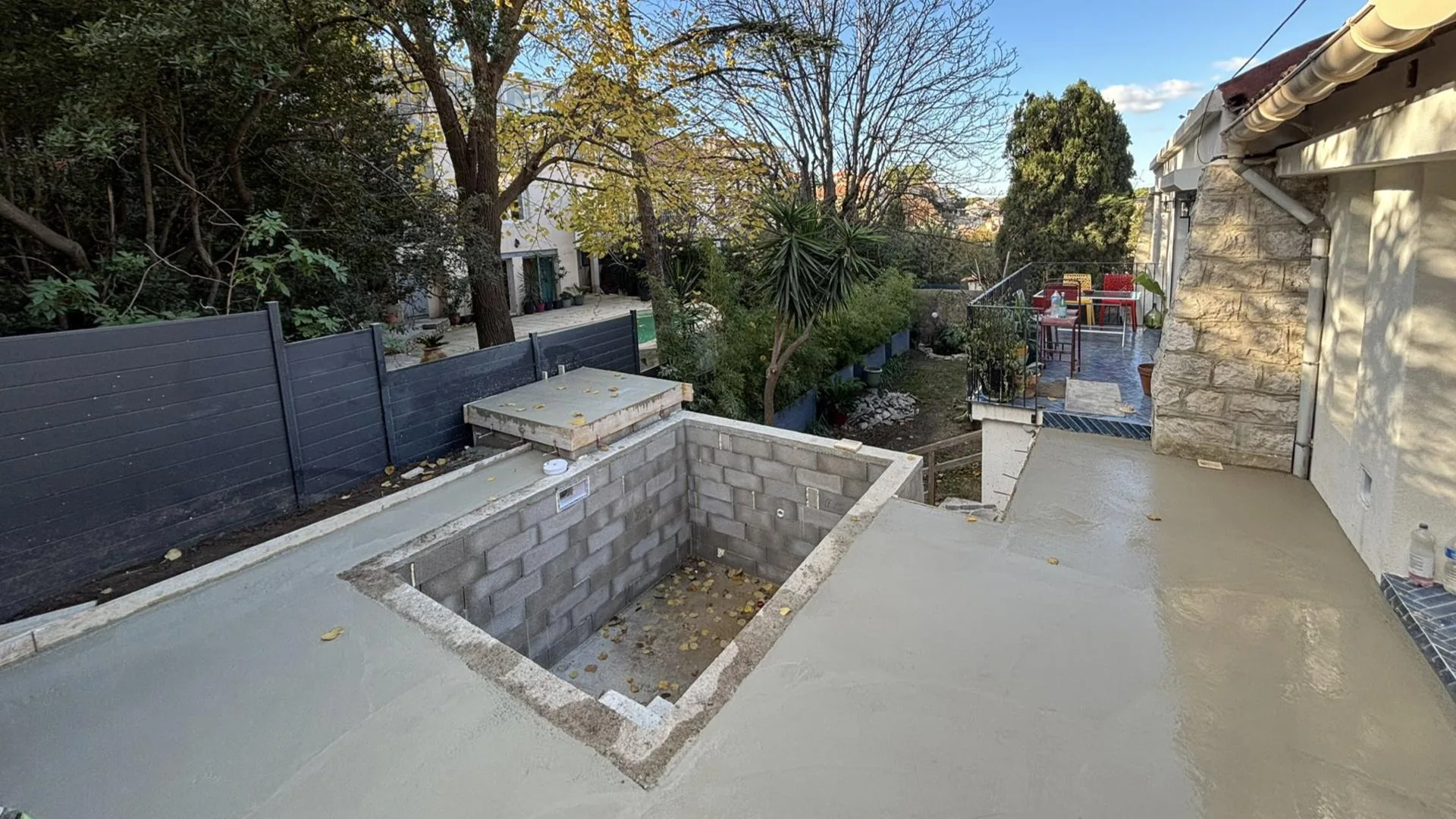
A related 240 × 220 cm built basin
A masonry project in a narrow terraced garden used dimensions of 240 × 220 cm, below 10 m², with access possible only by hand. Travertine paving, render matched to the house and bejmat accents connected it with the garden.
The small basin on a difficult sloping site gives the before-and-after and construction context. That related case is a small bathing-pool project, not evidence that an ornamental wildlife pond should use the same water-treatment system or safety classification.
The illustration remains useful for material continuity, access and level planning. Its intended use must remain clear when drawing lessons from it.
Define the water quality you actually need
A planted wildlife pond, a very clear decorative feature and a fish pond do not call for identical equipment. Water volume, depth, exposure, leaves, plants, fish and maintenance all affect the choice.
The source mentions sand filtration combined with UV as one possible clear-water arrangement. It is not a default specification for every pond; assess the actual solids and biological load and the appropriate equipment.
Mechanical filtration removes some debris, while a suitable UV clarifier can help control suspended microalgae. It is not a promise to eliminate every type of algae or replace the rest of the system.
Green water, organic deposits or mosquitoes can reflect several interacting conditions rather than one faulty component. The smaller the volume, the faster changes may become noticeable.
Calculate volume and actual pump performance
For an initial volume in liters, multiply length, width and average depth in meters by 1000. An irregular shape needs an appropriate volume estimate rather than pretending it is a perfect box.
The source gives a turnover reference around 1 to 2 hours for some fish-pond arrangements, with different needs for planted ponds. Confirm the actual system rather than adopting that as a universal requirement.
Account for head height and pipe losses, which reduce real delivery compared with a pump’s unrestricted advertised flow. Filter and UV selection need to work with that actual flow and volume.
A UV lamp’s service life follows the maker’s instructions; the article mentions seasonal replacement as a common reference. Compact pressure filters and larger settlement arrangements differ in access and cleaning needs, but no category guarantees less work in every pond.
Floating or floating-leaved planting such as suitable water lilies can reduce light reaching algae. The source uses roughly one third to one half of the surface as a planning reference, to be adjusted to the pond and planting rather than applied indiscriminately.
See our projects in video
Real floor plans and renovations explained step by step on the ArchiWorking YouTube channel. Watch how spaces are reworked before the works begin.
Fish are an option, not a requirement
A fish-free pond can support spontaneous wildlife with a different maintenance burden. Dragonflies, birds and aquatic insects may use it without the pond becoming a domestic-fish system.
Fish add waste and can disturb water or consume some larvae and plants. In a small volume, their welfare and water-quality requirements deserve particular attention.
Start with plant balance, partial shade, suitable depth and the intended ecological role. Do not introduce fish simply because a pond looks unfinished without them.
Plant in layers and check the exact species
The source groups plants into submerged oxygenating types, floating-leaved plants and marginal vegetation on the shelf. French examples include hornwort or water-milfoil types, water lilies, marsh iris, marsh marigold and water mint.
Those names describe roles, not a universal legal planting list. Exact species and local ecological suitability matter, particularly for milfoils and other aquatic plants that can escape into natural waterways.
The Spanish invasive-flora catalog lists examples including Myriophyllum aquaticum and certain Elodea species, alongside restrictions on water primroses. US readers need the relevant local guidance; familiar pond plants are not automatically safe introductions.
Natural predators can consume mosquito larvae, and moving water from a suitable small fountain or cascade may discourage breeding. Neither is a guarantee. Follow local public-health advice and avoid allowing neglected stagnant water to accumulate.
Services and electricity need a site-specific design
The French source gives examples of 30 mA residual-current protection and buried conduit around 50 cm deep with red warning mesh above. These are contextual references, not US electrical instructions or a safe universal burial depth.
Route, traffic, voltage, equipment and local rules determine the actual installation. Water-adjacent electrical work, outdoor sockets and pumps require suitable equipment and appropriately qualified design and installation.
Keep the filter or inspection access clear and consider a nearby water point for topping up where appropriate. The practical route for maintenance belongs on the drawing before the edges are finished.
Planning and permeable ground
The original legal discussion is French. Municipal rules, the PLU, protected settings, size, construction, depth, boundaries and impact on permeable ground can affect the proposal.
A masonry basin, slab or other impermeable construction may reduce the area that qualifies as pleine terre under local rules. A small footprint does not automatically remove that issue.
Check boundary distances, runoff, neighbor effects and maintenance access. An ornamental pond should not be assumed to inherit swimming-pool planning exemptions simply because both contain water.
As a swimming-pool reference only, the French framework generally distinguishes pools of 10 m² or less from those over 10 and up to 100 m², with prior declaration generally required in the latter case and protected-location exceptions in the former. Covers and other details can change the position.
The official French pool-planning guidance explains that framework. Confirm the actual classification and site rules rather than using the thresholds as a complete pond-permission answer.
Child safety cannot rely on an improvised detail
Even shallow water presents a drowning risk. Plan visibility, controlled access and suitable protection for the children and other users who may reach the garden.
The source mentions below-surface grilles, low fences and raised basins. None should be treated as adequate child protection merely because it exists. A grille needs appropriate engineered load capacity and secure installation; a low fence or seat-height edge may still be climbed.
Use suitable designed protection and attentive supervision rather than an improvised mesh or the belief that a small depth is harmless. The French statutory swimming-pool device framework does not automatically describe an ornamental pond, but absence of that particular duty does not make a pond safe.
If the feature is actually a bathing pool, check the applicable pool requirements regardless of a small footprint. The French private-pool safety guidance explains the relevant device framework, not US law.
A final design checklist
Confirm role, views, shade, nearby trees, proportions and wildlife escape. Check waterproofing, edge materials and structural feasibility before ordering a shell or liner.
Then confirm the intended water quality, whether fish are appropriate, equipment, actual volume, electricity and maintenance access. Finally verify planning, permeable-ground requirements, boundaries and family safety.
The minimalist Mediterranean garden guide develops the surrounding planting and mineral balance. A water feature succeeds when technical decisions and the wider garden support the same intention.
Questions about a small pond
Does it need fish?
No. A fish-free pond can support wildlife and a different balance. Decide from the intended role and maintenance capacity, not habit.
Can a pump alone keep it clear?
Not reliably. Volume, planting, exposure, organic load, equipment and cleaning need to work together. Choose the system after defining the pond.
Which waterproofing is best?
Shell, suitable liner and masonry systems answer different shapes and site constraints. The complete installation matters more than a universal material ranking.
Do depth references guarantee an ice-free pond?
No. The 20 to 30 cm shelf and 60 to 80 cm deeper-zone references need adjusting to climate, intended use and any fish requirements.
Does a small footprint remove safety or planning questions?
No. Intended use, location, construction, local rules and the people using the garden remain decisive, even where no specific planning application is required.
What should the first site review cover?
Look at the intended views, sun and shade, nearby trees, access, soil and level changes before selecting equipment. Then identify where services and maintenance can reach the feature without disrupting the rest of the garden. Those decisions help establish a credible size and location instead of forcing a purchased shell into the remaining space.
Why check permeable ground for a small feature?
Local rules may assess the effect of waterproof construction on the plot’s qualifying open soil. A small basin can therefore raise questions beyond its water-surface area. Verify the actual definition and site requirements rather than assuming that a swimming-pool threshold resolves every landscape issue.