
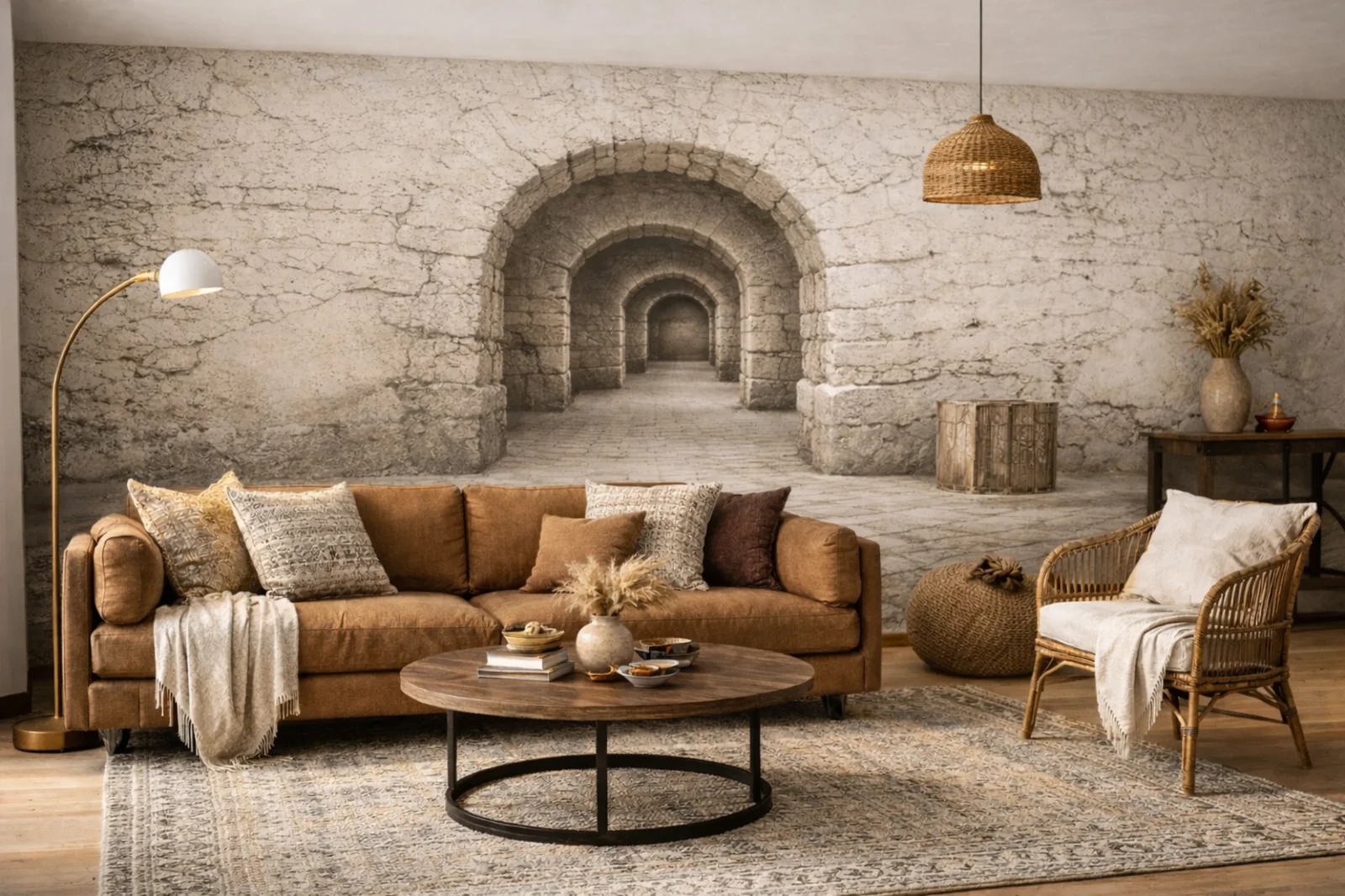
A perspective mural can change the way a room is read without changing its physical dimensions. Trompe-l’oeil uses a believable image to suggest depth, an opening or an architectural texture.
Choose the view for the room and its main viewpoints, not simply because the print is striking. A living room, bedroom, bathroom and small WC do not all need the same illusion.
Decide what the image should do
Perspective, converging lines and contrast can make a surface appear to continue beyond the wall. Aligning the image’s horizon and vanishing point with the intended viewing position can make the effect more convincing.
That position matters: an illusion designed for one view may look different from the side. It does not guarantee that every visitor experiences a larger room from every angle.
Forest, birch, seaside and botanical panoramas offer views associated with outdoors without adding furniture. They may create a welcome atmosphere, but a printed landscape does not provide daylight, ventilation or the physical benefits of an actual opening.
Two projects, two different roles
In a house-reorganization study, the reading room combined long pale-wood bookcases and white walls. Opposite the glazed opening, white-brick-effect wallpaper introduced architectural texture without constructing a masonry facing.
The effect belonged to the calm reading composition, not a requirement to add a dramatic distant landscape everywhere.
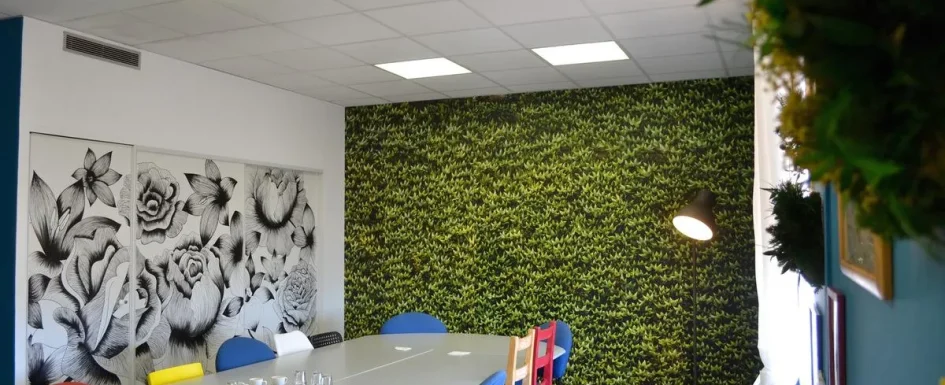
In an apartment intended for short-term rental, sloping wall lines and few right angles made the living area harder to organize visually. A large botanical panorama on the TV wall and a green-wall treatment behind the sofa created a stronger identity.
Both arrangements considered the principal views and natural light. The second photograph retains the botanical interior and black glazed partition rather than presenting it as another version of the stone-tunnel illustration.
Choose the subject by room
In a living room, a printed library is one traditional possibility. A city, nature or horizon panorama can instead suggest an outward view.
For a bathroom, a shoreline, jetty or mineral landscape may suit the intended atmosphere, provided the wall-covering system is appropriate to the location.
A bedroom might use romantic architecture, cathedral vaults or 18th-century-style moldings. The subject still needs to relate to the bed, furnishings and scale rather than compete with them.
In a WC, a birch forest or illustrated skylight may reduce the feeling of enclosure. It changes perception, not actual illumination, and does not remove the need for useful light.
See our projects in video
Real floor plans and renovations explained step by step on the ArchiWorking YouTube channel. Watch how spaces are reworked before the works begin.
A convincing picture needs a sound surface
Start with a dry, sound, clean and sufficiently smooth wall. Bumps, hollows and irregular joints can cast shadows that interrupt a printed perspective.
A scenic image is not a substitute for making good a damaged substrate. Where needed, an appropriate finishing skim and preparation should precede the wall covering.

The renovation planning guide places preparation within the sequence of work. Resolve the support before treating the mural as the final surface.
Check verticality and establish the first hanging reference with a level or laser. A pattern can reveal misalignment as the next strip is added, so do not assume following an irregular corner will produce a straight picture.
A laser line guides placement; it does not straighten a distorted wall or guarantee perfect matching without the rest of the preparation and installation being correct.
Match the wall covering to its exposure
Nonwoven products often allow paste-the-wall installation and useful dimensional stability, depending on the product. Follow its specified adhesive, wall preparation and strip sequence.
Vinyl, printed fiberglass or a treated textile may be options in a bathroom only where the complete system is approved for its actual exposure. A broad material name does not establish shower suitability.
Do not cover an actively damp wall and expect a vinyl layer to cure it. Investigate moisture, allow appropriate repairs and drying, and keep ventilation working.
Condensation resistance, washability and waterproofing are different properties. Neither a “breathable” claim nor a water-resistant face guarantees that adhesive, edges and substrate will remain sound in every wet location.
Place the illusion where it supports the layout
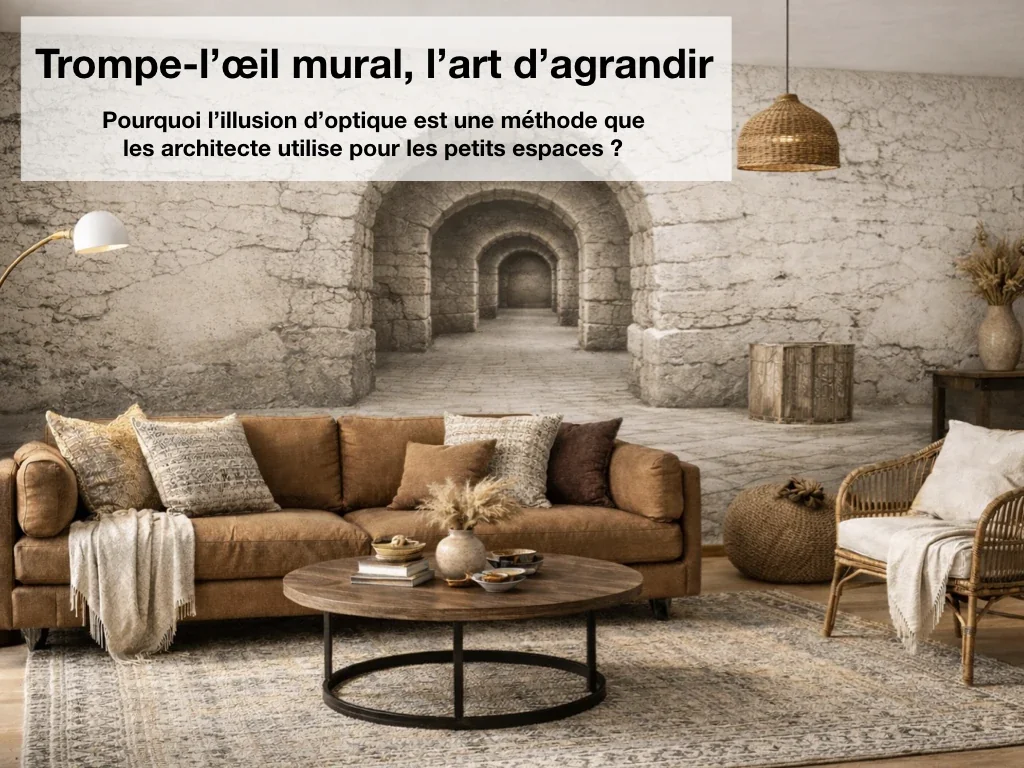
At the end of a narrow corridor, a receding image can extend the apparent axis. On a long side wall, a simulated window or glazed opening creates another direction of depth.
A lighter image may help the perceived brightness where light is available, but avoid promising that a printed skylight will light a dark passage.
The first and final stone-perspective visuals show the same general depth-building idea. Judge the scale against the sofa or other nearby furniture and from the route through the room.
Frequently asked questions
Can a mural hide an uneven wall?
Not convincingly when the illusion depends on clean perspective. Make good the surface first; shadows from bumps can contradict the printed geometry.
Is any vinyl suitable for a bathroom?
No. Check the complete installation system and actual water exposure. A decorative wall covering does not replace a shower waterproofing assembly or remedy damp.
Where should the vanishing point go?
Consider the main viewing position and natural eye line. Test the image’s scale and horizon in the room rather than assume one alignment works equally from every angle.