

Curtains belong in the room plan, not on the last-minute shopping list. Fabric, hanging length, heading, and hardware work together: a beautiful panel can still disappoint if it stops at the wrong height or blocks a door. Like a rug, a curtain adds a textile layer that makes a furnished space feel inhabited rather than merely equipped.
This article draws on Clara AJMAR’s interior-design experience, updated in October 2026. Her central point is practical: decide what the window needs to do before selecting its decorative finish. A living room, bedroom, and home office do not necessarily need the same degree of privacy, daylight, or enclosure. For a related textile decision, see choosing a rug for the room.
Start with the window’s job
A window brings light, air, and a sense of depth, but may also bring summer heat, winter discomfort, overlooking neighbors, or a harsh early-morning glare. Curtains filter and soften these effects while adding texture to the wall. They are not a substitute for sound glazing or a complete thermal strategy, but their everyday contribution can be considerable.
Think about the whole day. Does the room need filtered light while you work? Must it become dark enough for sleep? Is privacy needed after sunset? These questions help distinguish an airy sheer from a substantial curtain and identify where a double layer earns its place. A window treatment should answer the actual pattern of use, not simply resemble a photograph.
The fabric also has a visual job. Its folds create movement and depth that paint or a cabinet cannot reproduce. In a hard-edged room with stone, dark finishes, or strong joinery lines, that softness can change the atmosphere without changing the architecture.
Choose a fabric that keeps its shape
A very fine linen or smooth lightweight fabric can look irresistible in the store. In practice, some hold stubborn creases, develop an uneven drop, or age poorly in strong exposure. A curtain that needs constant ironing may not suit the way the household lives. Assess the weave and behavior, not only the color held against a sample card.
In an older west-facing apartment, a linen that was too light became uneven after only a few weeks. Direct afternoon sun and accumulated heat aggravated its deterioration. The lesson was not that linen is unsuitable, but that the particular weight and construction did not suit the window’s conditions.
Clara’s preference is to invest in a well-made pair intended to last for years rather than repeatedly replace a disappointing cheap set. Thick or medium-weight linen is a dependable starting point; fine velvet can suit a more dressed interior, and technical blackout fabrics suit bedrooms where darkness is important. None should be chosen without considering maintenance and exposure.

For bright rooms needing gentle diffusion, a sheer remains useful, especially with a second, denser curtain. Together they offer several settings over the day rather than a single open-or-closed choice. A sheer can soften daylight while the outer layer supplies stronger screening when required.
A simple preliminary test is to touch and lightly scrunch the sample, then release it. A crease that remains conspicuous warns that the fabric may demand more care than expected. This is a useful comparison between samples, not a guarantee of service life; ask about the fabric’s care and suitability as well.
Work out the heading and hardware before ordering length
There are four connected decisions: style, shape, length, and fixing system. Choosing the rod or track after buying ready-made panels is a common route to an awkward result. Wall and ceiling mounting establish different starting heights, while grommets, clips, and pleated heading tape each affect how the cloth hangs from that starting point.
Grommets use a few centimeters at the top; clips can change the effective length still further, depending on the fitting. Those small differences are immediately visible at floor level. A curtain that floats unintentionally or trails farther than planned can undermine an otherwise carefully composed room.
A bedroom beneath a sloping ceiling provided a useful warning. Ceiling mounting looked obvious on the drawing, yet the installed curtain visually interrupted the height. The rod had to be lowered and the hanging point reconsidered. A section drawing is useful, but it does not always convey how a full-size piece of cloth will feel in the space.
Before drilling, hold the actual curtain or an appropriate full-height trial in position. Check the fall, rod height, and floor relationship, then step back. The source describes this ten-minute check as preventing roughly 90% of unpleasant surprises: take that as the author’s practical expression of its value, not a measured guarantee.
Choose deliberately between just clearing the floor, meeting it, or forming a slight decorative break. The important point is intention and suitability for the room, not following one length rule regardless of doors, cleaning, and daily use. Recheck with the chosen heading attached, because the panel alone is not the final installation.
See our projects in video
Real floor plans and renovations explained step by step on the ArchiWorking YouTube channel. Watch how spaces are reworked before the works begin.
What the project examples show

In a renovated 70 m² apartment, large curtains dress the living-room glazing alongside retained dark parquet, a black wall, stone cladding, and furniture with industrial and Scandinavian influences. The fabric balances the mineral surfaces and dark palette while softening the window frame’s lines.
For broad glazed doors, the open curtain matters as much as the closed one. Check the gathered stack at each side so it does not take away comfortable access. Full-length fabric can make a room read taller, but only if the treatment still allows the opening to function naturally.
A second family-apartment example has ceilings over 3.30 m high. In the main bedroom, a 180 × 200 cm bed stands before a large preserved historic molding used as the headboard’s architectural backdrop. Mustard-yellow curtains echo the rug and bring warmth without altering the molding. Here the rod position and panel length are as influential as the bold color itself.
These examples illustrate a broader principle: curtains should work with the existing room rather than compete with every feature. Look for a relation to the rug, upholstery texture, or surrounding materials, then judge the whole view from across the room.
Match the layers to the room and the person
Balance three things: appearance, thermal and visual comfort, and actual use. A living room rarely needs total darkness throughout the day. A lighter decorative curtain may suffice, with a denser layer where exposed windows contribute to winter discomfort. A strongly sunlit south-facing bedroom has a different priority: protecting sleep may matter more than the lightest decorative effect.
One client was particularly sensitive to light spectrum and outside visual disturbance. Curtains allowed more precise control over intensity, while a sheer distributed a more neutral-looking daylight during the day. The example shows that window dressing can be a sensory-comfort decision, not merely an aesthetic accessory. The useful combination is the one that supports the occupant’s needs.
Roof windows require an appropriate system that follows the glazing’s slope. A conventional freely hanging panel cannot simply be assumed to work on an inclined opening. Select hardware intended for that condition. A double treatment can also be useful for exposed windows or rooms that are difficult to temper, provided its fixing and operation suit the opening.
Make the textile part of the composition
Curtains can repeat a rug color, respond to a sofa’s texture, or add a quiet contrast that gives the room depth. They may be handmade, woven, graphic, understated, or assertive. None of these choices works in isolation: the fabric should join the logic of the room rather than arrive as an unrelated final purchase.
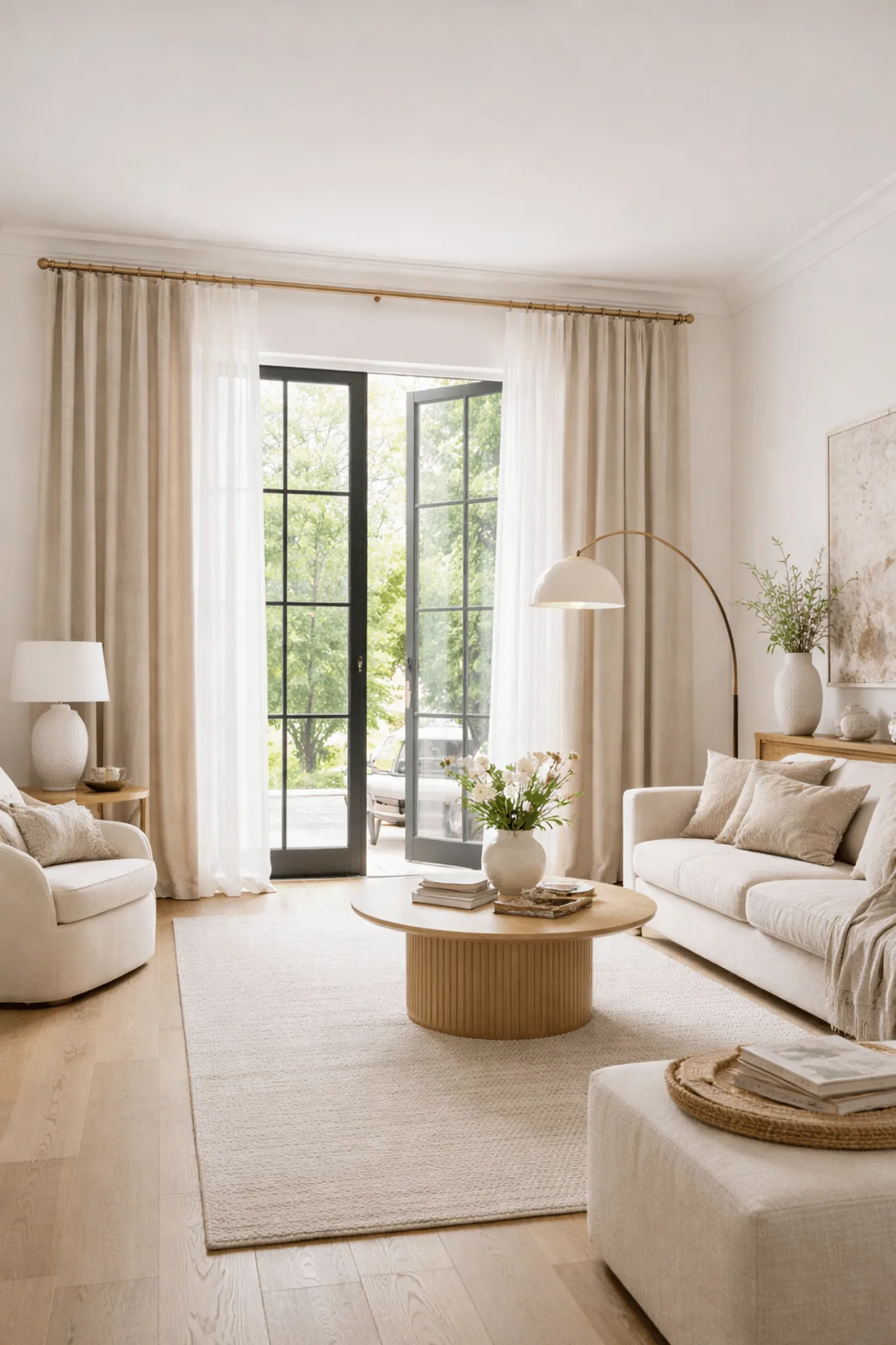
The source compares curtains to the finishing meringue on a tart: they complete the composition while doing a real job. Give their material, proportions, and support the same attention as the furniture and flooring. A durable choice helps structure the room and improve comfort; the cheapest or prettiest panel is not automatically the most economical long-term decision.
Common questions before installation
Can blackout curtains still look attractive?
Yes. Functional fabric and a considered color, heading, and proportion can work together. In a sunny bedroom, prioritize the darkness needed for sleep, then find the best decorative solution within that requirement. A living room may need a lighter balance.
Is ceiling mounting always better?
No. A high rod can visually extend a window, but a slope, molding, or particular room proportion may suggest another position. Decide the fixing first and test it at full size before ordering or drilling.
Is a sheer enough on its own?
It can be right for daylight diffusion, but it does not offer the same flexible screening as a sheer combined with a denser curtain. Consider evening privacy and the occupant’s light sensitivity as well as the daytime appearance.
How do I avoid a length mistake?
Measure with the intended hardware and heading, present the fabric in place, and check the drop from a distance. A short on-site trial is far easier than correcting every panel after the rod is fixed.