

Wall molding can organize a room through line and shadow rather than more furniture or pattern. Its role depends on the room’s proportions, use, ceiling height and palette, not simply on adding a historical detail.
In a home renovation, decide what should be retained, restored or reinterpreted. A tall period apartment and a recent building do not need the same profile or density of ornament.
Give every line a reason
Existing moldings can form part of an older apartment’s architectural character. When partitions change, matching or reinstating the appropriate details can help preserve continuity.
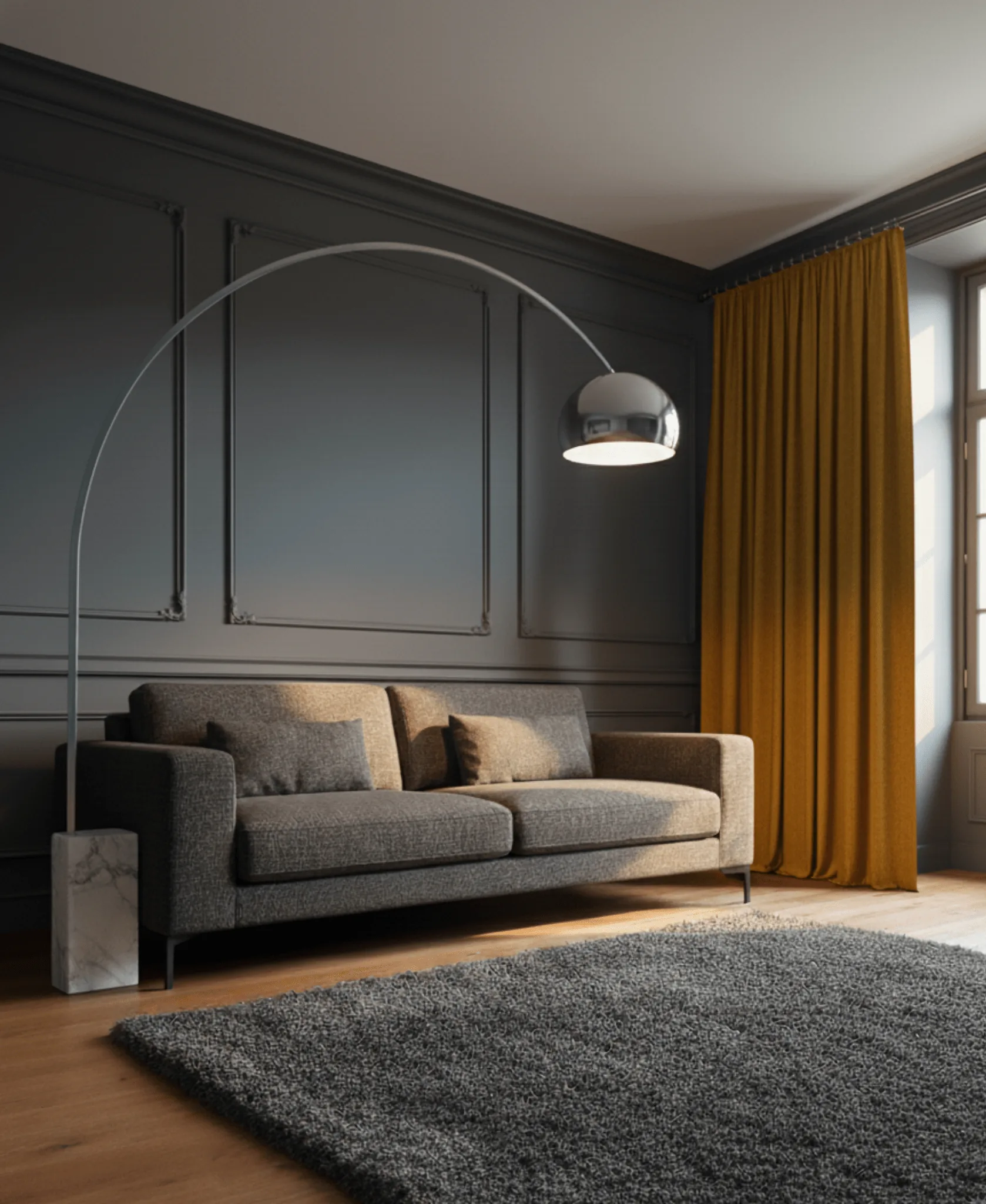
In a contemporary setting, simpler graphic profiles can reinterpret those references. Painted the same deep wine red or saturated blue as the wall, their relief reads through light rather than a contrasting border.
The dark-wall photographs illustrate rectangular framing within a gray living room, with a gray sofa and mustard curtains. The repeated source view shows how grazing light makes the relief visible without another color.
Greater height offers more possibilities, not total freedom to ignore proportions. In a room already rich in objects, leaving a wall plain may give a painting or important furniture piece the space it needs.
Choose the material for its position
Polystyrene is light and often economical, but vulnerable to impacts. It is more suited to protected high positions than areas regularly struck by furniture or cleaning equipment.
Denser polyurethane can give sharper profiles, with flexible versions available for suitable curved surfaces. Check the particular product rather than assume every polymer profile bends.
Plaster can provide a convincing match in a period interior but needs more specialized installation. Wood and appropriate MDF can suit rails and lower wall framing where a more robust detail is wanted.
Exposure and product specification matter. A dry-room MDF profile should not automatically be treated as suitable for damp conditions.
Use the maker’s compatible adhesive, often a specified acrylic or MS-polymer product, and the appropriate joint filler and coating. The adhesive family alone does not establish compatibility with every foam, paint or wall.
Case study: ceiling medallions on a dental waiting-room wall
In a dental practice occupying a Haussmann-style apartment, polystyrene ceiling medallions were used as a wall composition. The support was prepared before the pieces were bonded and painted one uniform shade.
Their shared color created relief and identity without multiplying competing tones. The source photograph preserves that arrangement on a pink wall.
This is a design example, not proof that any decorative foam is permitted in every commercial setting. The product and installation must still meet the relevant conditions for the premises.
See our projects in video
Real floor plans and renovations explained step by step on the ArchiWorking YouTube channel. Watch how spaces are reworked before the works begin.
Decorative repair is not a cure for an active defect

A medallion can finish an appropriately repaired area around a pendant’s supply point. A cornice may also integrate a ceiling-to-wall junction after work.
In the water-damage example, a plasterboard ceiling was repaired and corner moldings added at its meeting with the walls. They concealed the finished junctions and avoided extending some repainting.
That does not justify covering persistent damp, movement or unsafe electrical connections. Resolve the cause and repair requirements first, then decide how the decorative detail belongs to the completed surface.
Set the lower-wall height from the whole room
Around 90 to 100 cm is the article’s starting reference for a lower wall section. It is a composition guide, not an official ergonomic standard or mandatory height.
A rail can protect a vulnerable contact zone, create a line related to furniture and divide upper and lower finishes. Check its relationship to openings, room height and the actual objects nearby.
A suitably specified satin lower finish can help with cleaning. Its performance comes from the product, not the word “satin” alone.
Paint to unify or emphasize
Painting molding, baseboard and wall together can make the relief feel contemporary. A matte treatment reduces directional reflections; a contrasting or satin profile can produce a more explicitly classical reading.
Prepare and prime for the material where required by the system. Exposed corners are particularly unforgiving when adhesion or preparation is inadequate.
On a genuinely curved wall, choose a suitable flexible profile rather than force a rigid one into place. Minor gaps may be finished with compatible paintable acrylic, but filler should not conceal a substantial fitting problem.
Frequently asked questions
Do moldings always improve property value?
No. They can suggest care and character when proportionate to the building, but sale value depends on market and overall condition. A visual improvement is not a guaranteed financial return.
Must lower wall framing stop at 100 cm?
No. The 90 to 100 cm reference is an initial design aid. Test it against furniture, windows and ceiling height rather than repeat it mechanically.
When is a plain wall better?
When more relief would compete with an existing artwork, furniture piece or already busy composition. Choosing not to add molding can be a deliberate design decision too.