

Owning a pool is a pleasure, but keeping the water clean and clear takes method. A fundamental rule we repeat on every project: 80% of water quality depends on filtration, the mechanical action, and only 20% on chemical treatment. Choosing the right system at design stage means swimming without irritation and easier maintenance over time. To anticipate every key point, see our guide to the 10 essential points before a pool project.
By Clara Ajmar, qualified interior architect and DPLG landscape architect, 2025.
80% of water quality comes from filtration. Chemical treatment cannot make up for poor filtration.
Clara discusses a real pool project and its filtration choices in this video.
Filtration: the lungs of your pool
The filter you choose decides how finely the water is cleaned. Depending on the project, several options are available.
- Sand (or glass) filter: the most common, robust and easy to maintain. Using filter glass instead of sand improves filtration fineness and reduces water use during backwashing.
- Cartridge filter: excellent fineness and no drain connection needed. Ideal for small spaces or areas with water restrictions.
- Diatomaceous earth filter: for ultra-clear, premium water, but maintenance is more technical and the filter medium must be handled with care.
Whatever the filter, its size must match the pool volume and the pump flow rate, otherwise even the best technology will underperform.
Choosing a disinfection system: salt, chlorine or UV
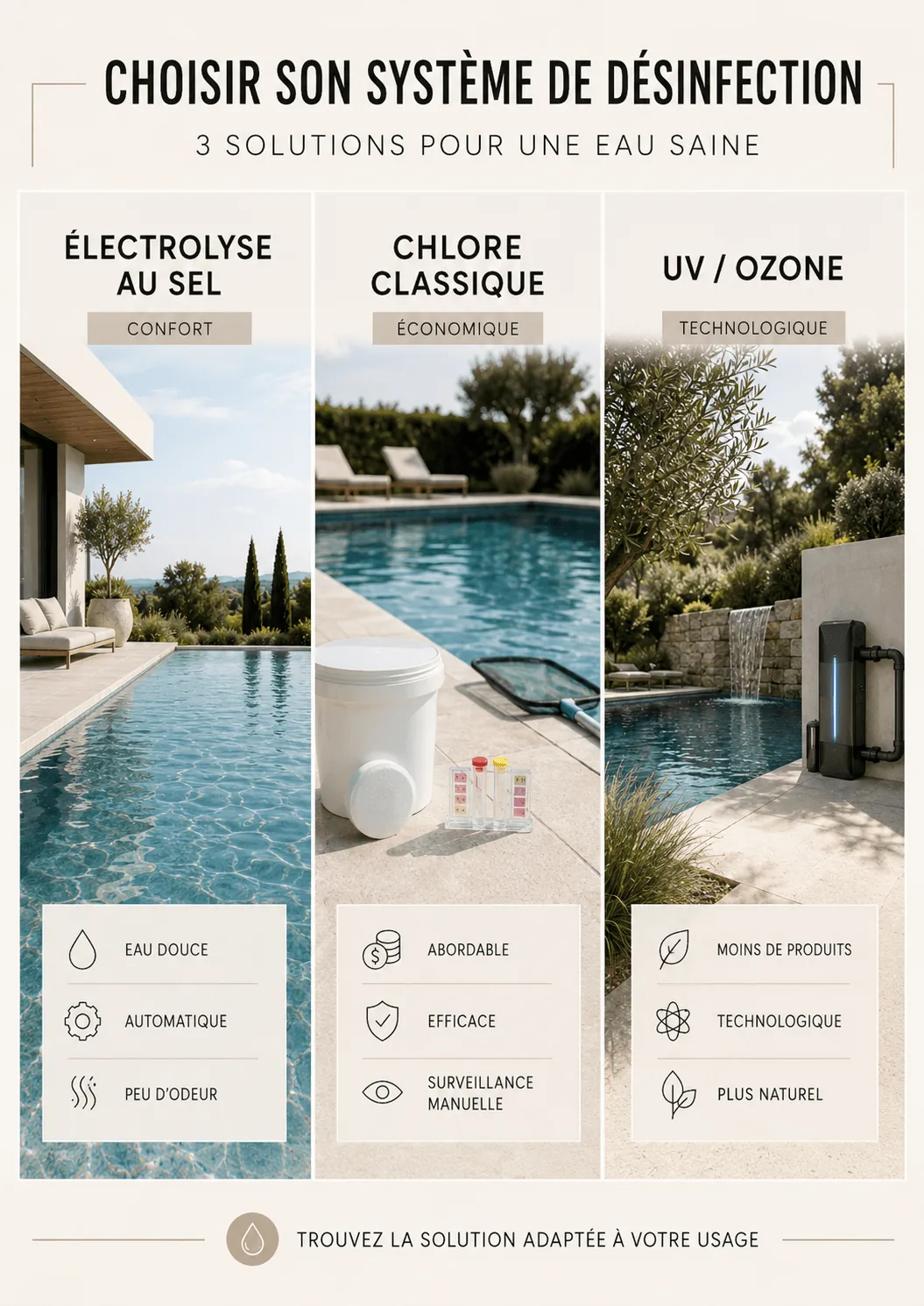
Once filtered, the water must be disinfected. There is no perfect solution, only one that fits your use and budget.
Salt electrolysis is very popular for swimming comfort: soft water and no chlorine smell. It is an automatic system that makes its own chlorine from the salt in the water. Traditional chlorine is cheap to buy and easy to understand, but requires careful manual monitoring of levels to avoid cloudy water or irritation. UV or ozone treatment are advanced technologies that sharply cut chemical use for more natural swimming.
See our projects in video
Real floor plans and renovations explained step by step on the ArchiWorking YouTube channel. Watch how spaces are reworked before the works begin.
Real budgets and running costs: pH controller, salt chlorinator and yearly treatment
The safety and filtration budget is often underestimated in early estimates. Here are the ranges seen on our projects for a standard residential pool of 30 to 50 m³, given as indicative prices for France in 2026, tax included.
Automatic pH controller, installed: 600 to 1,800 euros. This covers the unit, probe, injection, fittings and labor. It can be higher if the equipment room is hard to reach or the plumbing must be reworked.
Salt chlorinator, installed: 1,500 to 3,750 euros for a complete installation with a correctly sized unit, fine control and commissioning. Sizing is decisive: an undersized chlorinator wears faster, runs overloaded and gives less stable water in hot weather.
On yearly running costs, the difference is real, but the advantage of salt is not only financial. Traditional chlorine costs about 150 to 450 euros a year in products, sometimes more if the water often goes out of balance or the climate is harsh. Salt treatment runs 70 to 270 euros a year in routine consumables (top-up salt, pH corrector, cell care), but you must factor in replacing the electrolysis cell after a few years. The net yearly saving on consumables can reach 50 to 150 euros in favor of salt. Over time it is mostly a comfort choice: nicer water, less handling and more automated treatment.
Landscape architect’s tip: the secret of stable water is automation. A pH controller is the most cost-effective investment you can make: if your pH is off, no disinfectant works properly. With a salt chlorinator, a pH controller becomes almost essential, because electrolysis tends to push pH up. Without automatic control, maintenance turns manual again and swimming comfort suffers.
Field experience: for a 30 to 50 m³ family pool, chlorine remains the cheapest option to install. Salt becomes worthwhile when you want less handling, more comfortable water and steadier management in season. Either way, an automatic pH controller is the first investment to make: it stabilizes the system and makes the other equipment effective.
Pool filtration time: the rule you must know
A common mistake is trying to save on pump running time. The rule is simple: daily filtration hours equal the water temperature in °C divided by 2. If your water is at 28°C (82°F), it must filter at least 14 hours a day, during daytime, when sunlight and swimmers affect water quality most. Cutting this time to save electricity gradually unbalances the water and multiplies corrective treatments.
Safety around the pool is the other pillar of worry-free use: see the legal requirements and approved devices in pool safety: legal requirements and the best solutions. The equipment room that houses the pump, filter and controllers also deserves planning from the start: our guide on planning the equipment room, the operational heart of your pool details space, access and installation constraints.
Maintenance and water quality
Why does pool water turn cloudy despite treatment?
It is often a sign of insufficient filtration, a clogged filter or an unbalanced pH. Check the filter pressure before adding chemicals: adding chlorine to water whose pH is out of range will change nothing and make the imbalance worse.
Is a salt chlorinator compatible with all pool equipment?
Salt is corrosive. If you choose this system, make sure your equipment (ladder, pump, heat exchanger) is compatible or protected by effective grounding. Always check this with your pool builder before installation.
Think about maintenance at design stage. Well-managed water extends the life of your lining, whether liner, membrane or tile. With quality filtration and automatic pH control, maintenance becomes a simple occasional check. Find all our advice under the pools and water features tag and on the ArchiWorking channel.