
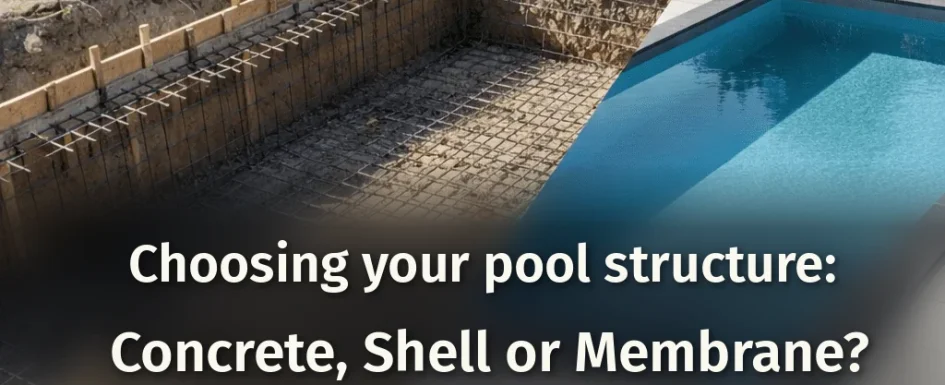
The structure is the engine of your project. It decides how long the pool lasts, how far it can be customized and the overall budget. There is no standard pool: every project differs with the ground, the uses and local constraints. Before deciding anything, read the 10 essential points before starting a pool project.
By Clara Ajmar, qualified interior architect and DPLG landscape architect, 2025.
The structure is the skeleton of your project. Saving on the structural work is almost always a bad long-term calculation.
Clara discusses how to choose between the three structures in this video on the key points of a pool project.
The concrete pool: the unbeatable custom option
Concrete, whether poured in one piece, cast in formwork or sprayed, remains the benchmark for high-end projects and complex sites. It offers total freedom of shape, size and finish: large-format tile, mosaic or natural stone. It is also the most durable structure, lasting more than 50 years when well built. Only the waterproof lining, liner or tile, needs renewing every 15 to 20 years depending on use and care.
- Main point to watch: concrete needs at least 28 days to cure before the pool can be filled. This delay cannot be shortened and must be built into the schedule.
- Good to know: if you want large-format porcelain tile for a mirror effect, concrete is your only viable option. Shells and membranes do not offer the rigidity that finish requires.
The fiberglass shell: fast installation and built-in waterproofing
Factory-made, the shell pool appeals through its simple installation. Once the excavation is done, the shell is set and connected in a few days. Waterproofing is built in, so no extra lining is needed in the early years.
A shell is sensitive to ground movement and hydrostatic pressure, so perimeter drainage is essential. Sizes are also limited by road transport rules. One point many owners discover too late: delivery happens in two separate legs. The first runs from the factory to your lot, point A to point B. The second runs from the lot entrance to the pool location, point B to point C. That second leg depends entirely on access width, turns, gate height and any power or high-voltage lines above the route. An access that looks obvious from the street can prove impossible for a crane or an oversize truck, so check it before ordering.
The reinforced membrane (150/100 reinforced PVC): the answer for complex shapes and renovations
A structure waterproofed with a 1.5 mm reinforced membrane is now frequently recommended for complex shapes or renovations. Unlike a standard liner, the membrane is welded on site and resists UV and temperature swings better. It is the best fit when the pool shape does not match a standard shell, or when renovating an existing concrete pool whose lining needs redoing.
See our projects in video
Real floor plans and renovations explained step by step on the ArchiWorking YouTube channel. Watch how spaces are reworked before the works begin.
Landscape architect’s tip: choose the structure according to the final finish too. If you dream of large-format porcelain for a mirror effect, concrete is the only viable option. With a shell, finish options are limited to what the manufacturer offers.
Field experience: a smaller pool built on a robust, lasting structure is better than a big fragile one that needs costly repairs after a few winters. Over time, savings on structural quality are almost always caught up and exceeded by repair costs.
Real budget and timelines by structure
There is no standard pool. Each project is a unique combination of ground, structure, equipment and surroundings. The first rule before comparing: get at least two detailed quotes from different pool builders, with identical scopes, so they can be compared like for like.
As an indicative range for France in 2026, on the projects we support, excavation, structure, basic equipment and connections typically come to around 30,000 to 40,000 euros depending on options, site complexity and the chosen setup. The surroundings, decks, planting, lighting and safety devices, come on top and can be a significant share of the total budget.
As for timing, from the first dig to filling the pool with its surroundings complete, allow on average 2 to 6 months depending on the scope. The fastest projects are shells on simple ground without complex landscaping. Concrete projects with decks, planting and full equipment sit at the top of the range. How the equipment room is organized also affects the schedule: see our advice on planning the equipment room, the operational heart of your pool.
Questions about choosing a pool structure
Which structure suits difficult or unstable ground?
On unstable, clay or sloping ground, reinforced concrete with deep foundations (piles) is the best way to make sure the pool does not crack over time. A shell is not recommended on ground prone to movement, as it is sensitive to changes in the substrate. A G2 soil study remains the essential first step to size the foundations correctly, whatever the structure.
How long does a concrete pool last?
A well-designed concrete structure can last more than 50 years. Only the waterproof lining needs renewing: every 15 to 20 years for a liner, longer for tile or reinforced membrane depending on care and exposure. The structure itself, if properly sized and built, is not meant to be redone.
What are the size limits for a transportable fiberglass shell?
Shell transport is governed by road rules for oversize loads. But beyond legal dimensions, the route from the factory to the exact pool location decides feasibility. It has two legs: from the road to the lot entrance, then from the entrance to the pool site. Each must be analyzed separately: access widths, turns, gate heights, high-voltage lines or trees above the route. A shell that fits on the road may be impossible to deliver to the planned spot, so check this with the pool builder before ordering.
Find all our pool advice under the pools and water features tag and on the ArchiWorking channel.