
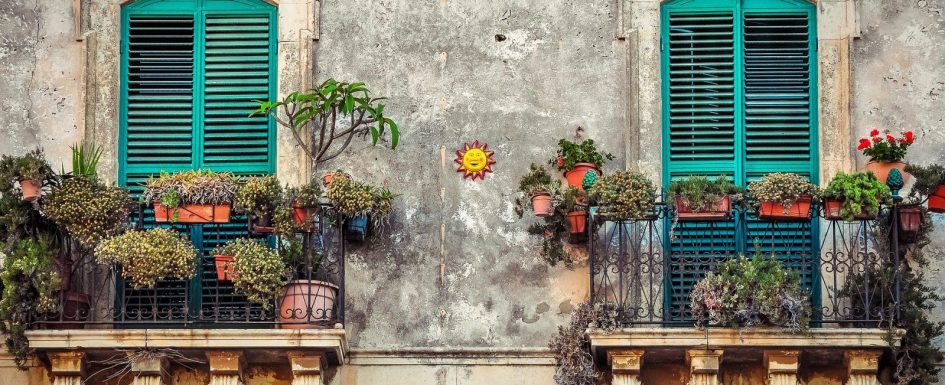
A planter is more than a container for flowers. It can brighten a winter balcony, screen an overlooking window, mark the edge of a dining area, or bring planting up to eye level. Decide which job it needs to do before choosing its shape or plants. The useful soil depth, drainage, exposure, and eventual root growth will determine whether the display lasts beyond its first season.
Begin with the container and its position
Railing planters, hanging pots, and freestanding boxes can all make a small outdoor space more welcoming. Check how each will be supported and watered, how much sunlight it receives, and whether it leaves a clear walking route. Something attractive in a photograph may be too shallow for the intended plants or too heavy for the support available.
Useful soil volume is especially important. Perennials and small shrubs need more depth than a temporary display of pansies; that extra volume also affects water reserves and protection of roots. Compare the number and diameter of drainage holes before buying, not after the plants are installed. Keep those openings functional throughout the year.
Terracotta, suitable exterior timber, and galvanized metal can reinforce a rustic appearance, but each behaves differently. Timber needs a durable species or treatment appropriate to damp outdoor conditions, with a protective geotextile lining that does not block drainage. Metal heats rapidly in sun and may dry the growing medium during summer. Resin or suitable fiber-cement products may reduce container weight, although the actual product must be checked rather than assuming every model is light.
Terracotta breathes and helps regulate moisture, retaining a little daytime warmth. It does not reliably protect roots from severe frost. Choose a product guaranteed frost-resistant; ordinary terracotta may crack when frozen. In winter, insulating the sides and grouping pots against a sheltered wall provides more protection than relying on the material alone.
Drainage: do not confuse a gravel layer with an outlet
Water must be able to leave the planter through clear holes and a structured growing medium suited to the plants. A layer of gravel or clay pebbles at the bottom does not improve that outlet. It takes space away from roots and can leave water held in the soil immediately above the layer.
Avoid saucers that retain water during freezing weather. Raise the container on suitable feet or blocks so drainage can remain open. The aim is to prevent waterlogging, root suffocation, and rot, not to make every mix equally dry. A moisture-loving plant and a cactus need different growing media and watering regimes even if both are in well-drained pots.
Build winter interest from foliage and hardy plants
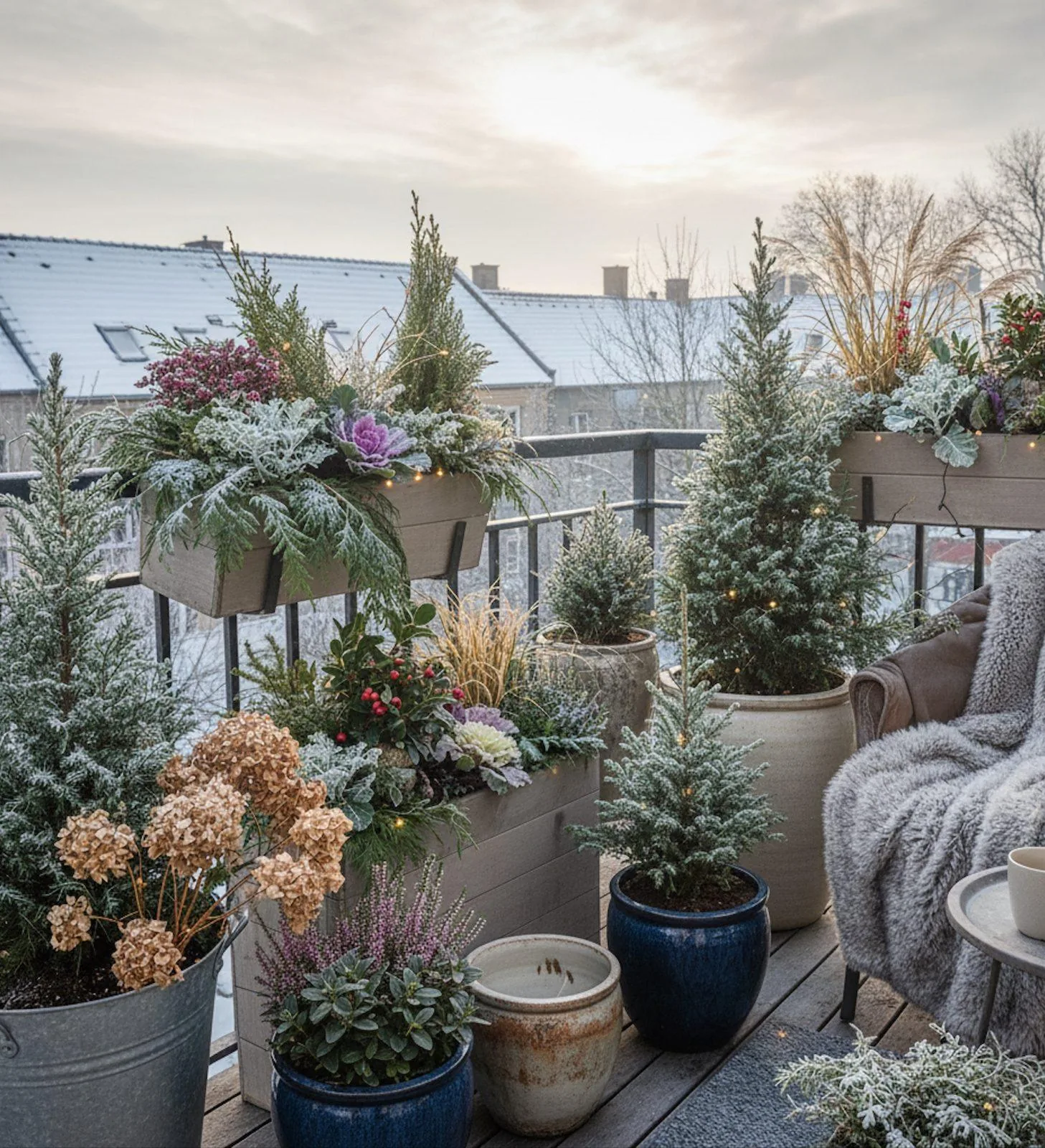
Cold weather does not have to empty a balcony of color. Deep red, rich green, bright yellow, and clear white can create contrast visible from inside the home as well as outside. Evergreen foliage supplies the lasting structure; flowers can provide seasonal changes without carrying the entire composition.
Pansies and violas give a long, resilient flowering display. Heathers add fine texture and pink or white tones. Hellebores, often called Christmas roses, flower during winter. Ivy, heucheras, and dwarf conifers help build evergreen structure, while compact grasses bring movement and a lighter outline. Our guide to winter plants offers other possibilities.
Check each plant’s stated hardiness, meaning the minimum temperatures it tolerates, against the actual conditions. Roots in a pot are more exposed to cold than those in the ground. Also check light: hellebores generally prefer partial shade, while small conifers and many grasses favor sun. Species and cultivar requirements still take precedence over broad plant-group descriptions.
Compose with heights, forms, and compatible needs
Use trailing plants at edges and stronger upright forms toward the center or rear as the viewing position requires. Contrast glossy and matte foliage, smooth and divided leaves, rounded and vertical shapes. A green framework with one or two stronger colors and small repeated accents can remain legible from indoors without becoming visually busy.
On a 50 m² terrace study, we applied these principles to a long linear planting composition. The occupants wanted predominantly green foliage, touches of white flowering, and enough plant growth to conceal the exposed soil. We considered grasses for movement, perennials including hostas and pineapple sage (Salvia elegans) for foliage variety and scent, and cacti for contrasting silhouettes and textures under suitable growing conditions.
These were families to organize across the design, not a recipe to mix indiscriminately in one box. A hosta that prefers moisture and partial shade should not share a container with a cactus needing sun and a very free-draining substrate. Separate aligned containers can preserve the visual line while allowing different water, light, and soil requirements. The goal was continuity without creating a uniform hedge.
See our projects in video
Real floor plans and renovations explained step by step on the ArchiWorking YouTube channel. Watch how spaces are reworked before the works begin.
Use vertical space without blocking the balcony
On a narrow balcony, planting can rise instead of spreading over the floor. Options include hanging containers at different levels, metal supports, plant ladders, modular wall systems, and railing-straddling pots with secure purpose-made attachments. Consider access for care as well as the effect from the room: a display should not become impossible to water safely.
Secure every suspended planter carefully, particularly on a facade. Supports and fixings must suit the load, substrate, and exposed position. A colorful suspended garden is only successful if it leaves circulation clear and cannot fall onto people below. Keep spiny plants away from routes where they could injure someone.
Screening views: a terrace case study
In another landscape study, the terrace included a dining area with a round table 140 cm in diameter, an outdoor sitting area, and a relaxation space. Neighboring buildings overlooked it strongly. We proposed a sequence of rectangular and circular containers in dark-gray and textured-black finishes to build several layers of planting rather than one continuous wall.
The studied palette included Italian cypress, pittosporum, stipa grasses, lavender, creeping ceanothus, and climbing plants. Upright forms filtered higher views; lower planting related to circulation and furniture. Each choice still depended on exposure and growing conditions. The example shows why a planter’s purpose should lead the composition, not simply its flower color.
Check the load before installing large containers
For a balcony or raised terrace, add the container, growing medium saturated with water, and mature plants. A large planter can readily total several hundred kilograms. Have the supporting structure checked by the appropriate building manager, architect, or structural professional before installation. Do not estimate capacity by appearance.
Where approved by that assessment, keep heavy loads close to structural supports rather than arbitrarily in the middle of a slab, and consider a suitable lightweight growing medium for large boxes. Load position must follow the actual structural advice. Our small terrace and balcony article develops other ways to use limited space.
Care and safety through the seasons
Choose plants that will not rapidly outgrow their container. Check their mature size rather than relying on the small specimen in the nursery. A water-reservoir planter can reduce drought stress if watering is sometimes missed, but it needs to suit the planting and seasonal conditions rather than becoming a permanent waterlogged reservoir in winter.
Check toxicity where children or animals have access. Oleander, holly, and some berry-bearing plants can be hazardous; sharp plants need separation and protection. Combined with sound drainage, safe fixings, and appropriate exposure, these choices support both appearance and longevity. For propagating favorite plants more economically, see taking plant cuttings; for the whole space, read planning an outdoor terrace.
Do I need clay pebbles at the bottom?
No. Open drainage holes and a suitable structured growing medium are what matter. A bottom layer reduces useful soil volume without improving the outlet and can leave moisture perched above it.
Does terracotta prevent frost damage to roots?
Not reliably. Use frost-resistant containers, insulate sides where needed, raise them to keep drainage clear, and group pots against a sheltered wall. Potted roots remain vulnerable in severe cold.
How heavy is a large balcony planter?
Include the container, fully wet growing medium, and mature vegetation. Several hundred kilograms is possible, so obtain a load-capacity assessment and placement advice before installing it. A lighter container does not remove the need for that check.