
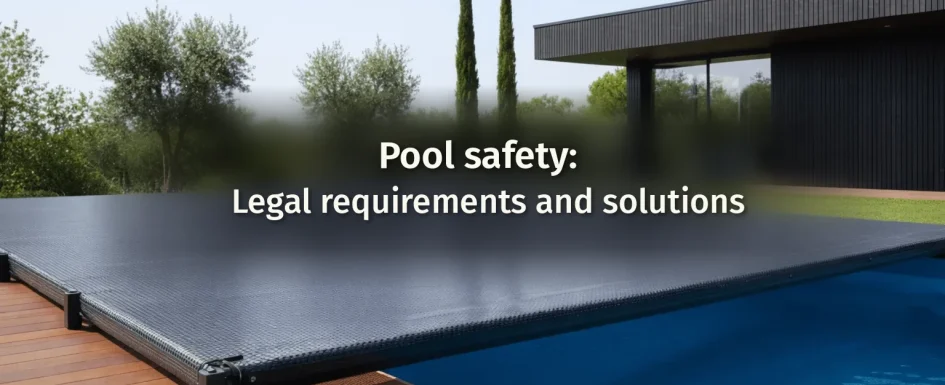
Safety is not optional. It is an absolute priority and, in France, a legal obligation since the law of January 3, 2003. We build safety in from the design stage so that it is not felt as a visual constraint but as a harmonious part of the project. Only a safe pool lets you enjoy your garden with peace of mind. To anticipate every key point, see our guide to the 10 essential points before a pool project.
By Clara Ajmar, qualified interior architect and DPLG landscape architect, 2025.
A safety device that is well integrated from the design stage goes unnoticed. That is exactly the goal.
Clara discusses pool safety devices and ways to integrate them in this video.
The 4 approved devices for securing a pool (French NF standards)
To comply, your pool must have at least one of the following four devices, meeting AFNOR standards:
- Safety barriers (NF P90-306): they must stop children under 5 from getting through and have a self-closing gate.
- Alarms (NF P90-307): perimeter or immersion alarms must detect a child falling in and sound a siren.
- Safety covers (NF P90-308): automatic slatted covers, bar covers or motorized covers. Often the most attractive and versatile choice.
- Pool enclosures (NF P90-309): high or low, they make the pool completely inaccessible once closed.
Pool safety budget: real ranges by device
Safety is often missing from early estimates. Here are the ranges we see on our projects, given as indicative prices for France in 2026, excluding installation, which depends on the site:
- Approved alarm: 200 to 600 euros. The cheapest device, but also the most passive: it warns of an accident without physically preventing it.
- Safety barrier: 1,500 to 5,000 euros depending on the perimeter, the materials (powder-coated steel, aluminum, glass) and the complexity of the layout. This is the device we most often recommend first.
- In-pool or above-deck slatted cover: 6,000 to 10,000 euros. The go-to solution when you want a pool with no visible barrier. It can be added to an existing pool, which makes it a reversible option that adds real value to the property.
- Pool enclosure: 8,000 to 25,000 euros depending on height, area and finish. The most protective option and the one that most changes winter use.
See our projects in video
Real floor plans and renovations explained step by step on the ArchiWorking YouTube channel. Watch how spaces are reworked before the works begin.
Field recommendation: on most of our projects, we recommend a barrier first. Well designed, it blends in, lasts and truly protects rather than just warning. A slatted cover is the most coherent alternative when the owner wants no visible barrier. Either way, the device must be planned at design stage, not added after the pool is handed over.
Landscape architect’s tip: safety works in layers. The legal device is mandatory, but nothing replaces adult supervision. An automatic cover is an excellent choice because it also keeps the water warm and limits evaporation, two direct savings on running costs.
Design serving safety: integrating without spoiling the look
Owners often fear that safety will ruin the pool’s design. Modern solutions allow complete integration.
An in-pool slatted cover is housed in a box under the deck or in a bench. It disappears entirely when open and keeps the clean lines of the pool. A glass barrier suits contemporary gardens and gives full protection without breaking the view of the landscape. A powder-coated aluminum barrier fits more traditional projects, with excellent durability and almost no maintenance.
How the pool surroundings are designed plays a direct role in the overall visual coherence. To see how safety, materials and planting come together around the pool, read designing the pool surroundings as a living space.
Penalties and liability for non-compliance
In France, failing to meet these obligations can lead to a fine of up to 45,000 euros. Beyond the money, the owner’s criminal liability is at stake if an accident happens. For owners who rent out their property, compliance is a key insurance checkpoint: a claim on a non-compliant pool can be refused. Keep the device’s certificate of conformity and installation invoice with your property documents, as they will be requested after any incident or at resale.
Your questions about mandatory pool safety
Is an alarm enough to comply with the law?
Yes, an alarm approved to NF P90-307 is legally sufficient. However, it is the most passive device: it warns of an accident without physically preventing it, unlike a barrier or a cover. For families with young children, we never recommend an alarm as the only device.
Does an above-ground pool need to be secured?
Inflatable or removable above-ground pools are not covered by the 2003 law. As soon as a pool is in-ground or semi-in-ground, even partly, the law applies without exception.
Once safety is in place, water quality is the other pillar of worry-free use. See all our advice on filtration and water treatment for a crystal-clear pool, and more pool and outdoor tips on the ArchiWorking channel.