

Pallet wood can become a useful piece of furniture rather than an unfinished salvage project. Its appeal is straightforward: a visible timber texture, a modular construction and the chance to personalize an interior without starting from expensive new furniture.
The result depends less on finding a free pallet than on choosing sound material, preparing it properly and giving the finished piece a clear role. Paint, cushions and accessories cannot compensate for an unsuitable or unstable base.
Choose the timber before choosing the color
Pallets can be bought or recovered with the owner’s permission. Do not assume that a pallet outside a store has been abandoned: some belong to a return system.
Check its condition and known history. Reject cracked or badly damaged boards, protruding or unsafe fixings, suspect stains and material with uncertain contamination rather than try to conceal problems under paint.
The source distinguishes HT, meaning heat treatment, from MB, methyl-bromide treatment. Avoid MB-marked pallets for this domestic reuse.
An HT mark describes a treatment process; it does not certify that subsequent transport, storage or spills left the pallet clean, nor that it is approved furniture. Do not read it as a universal indoor-safety guarantee.
That distinction matters before sanding. An unknown spill is not made harmless by smoothing the surface or applying varnish over it.
Decide what the piece must do
A pallet may become a bench, coffee table, bed element, shelf or planter. Each use imposes different demands on support, cleaning, contact and stability.
The material’s modular character makes disassembly and reassembly possible, but not effortless or automatically safe. Plan the intended shape before taking apart boards or keeping a transport frame unchanged.
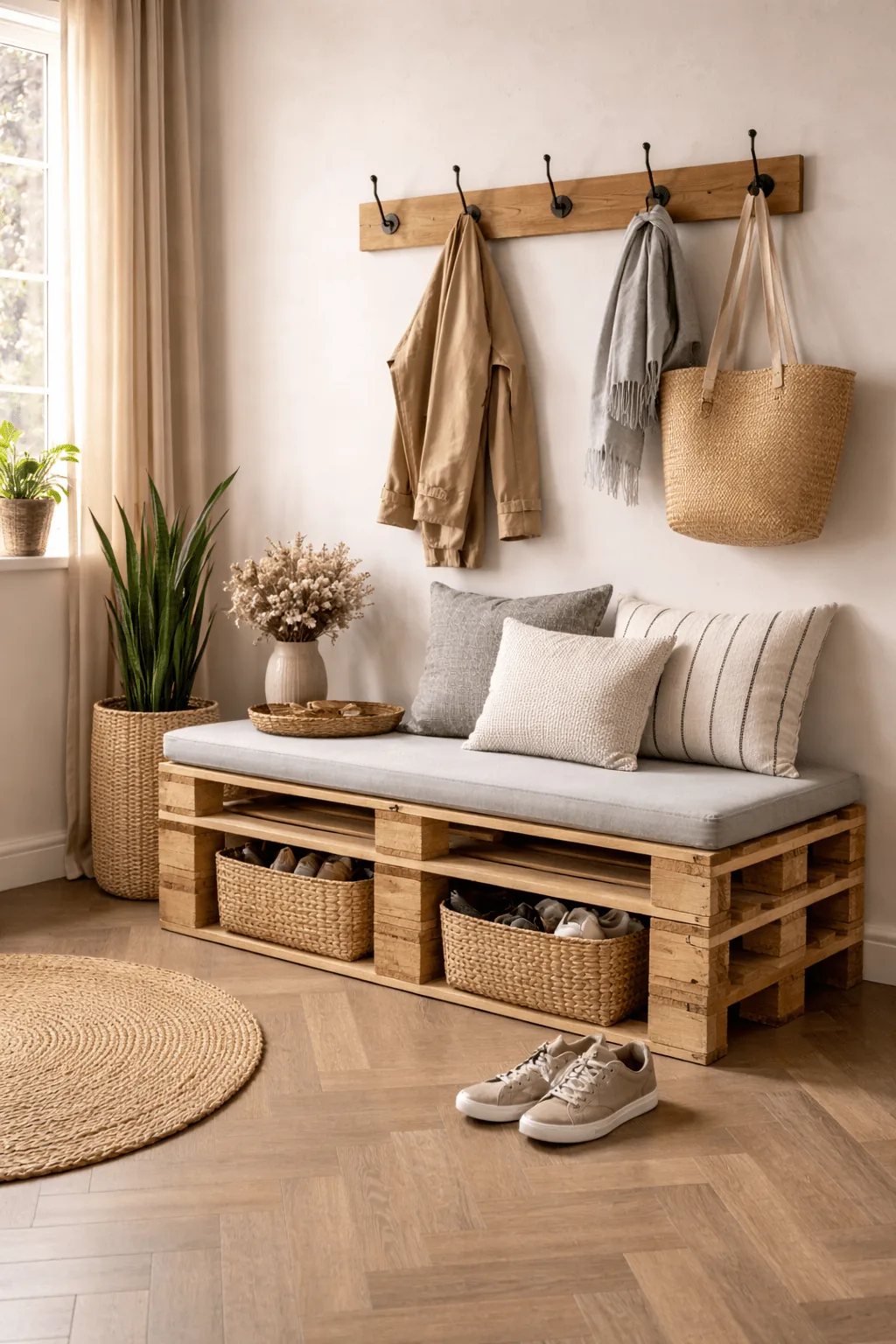
The entry bench is the source’s favored practical example. A cushion, baskets for shoes and accessories, and wall hooks can turn a small arrival area into a coherent arrangement.
Check the actual seat height, depth, strength and stability rather than assume every pallet happens to be ergonomic. Baskets should be reachable without catching hands on rough edges or nail heads.
The retained entry photograph shows that combination of seating, cushions, baskets and hooks. It is a useful reference for organization, not a construction certificate for any salvaged pallet.
Prepare the wood in stages
For suitable, uncontaminated timber, the article proposes a coarse sanding stage to remove roughness, followed by finer sanding for a smoother surface. Inspect joints, edges and accessible undersides as well as the most visible face.
Use appropriate dust protection and controlled collection. The aim is a surface that can be touched and cleaned, not merely one that looks smooth from across the room.
Remove dust before applying the finish. A coating cannot be expected to bond evenly over loose debris, splinters or incompatible residues.
For paint, choose a primer compatible with the wood and the finishing system. It can help manage uneven absorption and improve consistency, but does not repair weak boards or make unsuitable timber suitable.
For a clear finish, use any compatible transparent sealer specified by the manufacturer rather than automatically applying an opaque paint primer that hides the grain.
See our projects in video
Real floor plans and renovations explained step by step on the ArchiWorking YouTube channel. Watch how spaces are reworked before the works begin.
Two finish directions, one level of care
A clear varnished finish retains the timber’s variation and reclaimed character. Select the product for the intended use and follow its preparation, drying and curing instructions.
A strong painted color gives the piece a different presence. Relate it to the rest of the room instead of choosing a bright shade only to disguise the pallet’s origin.
The source’s workflow is preparation, an appropriate base treatment and the final coating. The products in those stages must work together; more layers do not automatically mean a better finish.
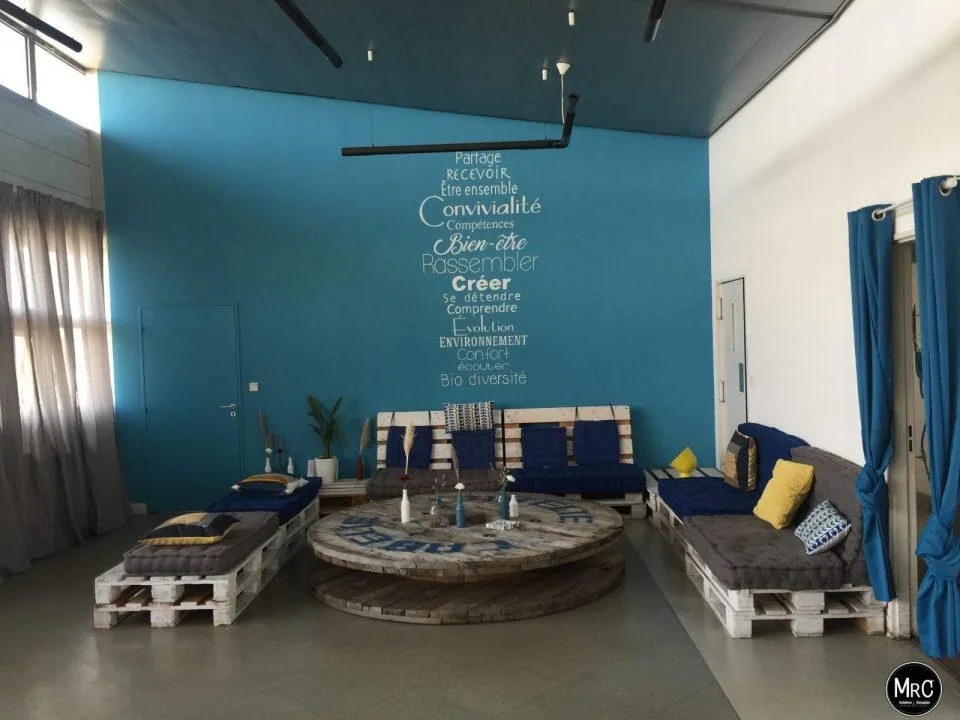
The living-room photograph preserves pallet seating and a coffee table in front of a blue wall. The palette and textiles help the pieces read as a deliberate arrangement.
Coffee tables and headboards need their own checks
Two stacked pallets with casters are a familiar coffee-table idea. Assess the assembly, fastening, stability and wheel capacity for the finished use rather than simply placing one frame on another.
A movable table also needs a workable relationship to the sofa and circulation. Its ability to roll does not resolve an unsuitable height or exposed fastener.
A headboard can emphasize the graphic rhythm of the boards. Differently colored slats or integrated lighting are possibilities, but electrical components, heat and cable routes must be compatible with the timber installation.
The same care applies to a bed, shelf or planter. A transport pallet’s previous job does not establish the suitability of its new arrangement.
Avoid a room made only of salvage gestures
One reclaimed piece can gain definition beside a well-chosen textile, a quieter object or a plant. Filling every corner with unrelated salvage can obscure the intended composition.
For an armchair, the source suggests visible varnished timber with black-and-white graphic fabric or copper-toned textiles, tied together with white. That is a palette idea, not a required recipe.
The target is coherence rather than a claim that reclaimed furniture is inherently inferior or automatically equal to high-end joinery. Preparation and use matter more than either label.
Frequently asked questions
Does HT mean any pallet is safe indoors?
No. It identifies heat treatment, not cleanliness, condition or furniture approval. Known history and a sound, suitable construction still matter; avoid MB-treated material.
Must the wood be primed before clear varnish?
Follow the compatible coating system. An appropriate clear sealer may be specified; an opaque paint primer is not a universal first layer for a visible-grain finish.
Why does the entry bench work well?
It combines a clear everyday use with cushions and accessible storage. Its dimensions and structural adequacy must still be verified for sitting.
How can the result avoid looking unfinished?
Give it the preparation, edge treatment, finish and surrounding composition you would expect from intentional furniture, rather than relying on the word “reclaimed” to excuse poor execution.