
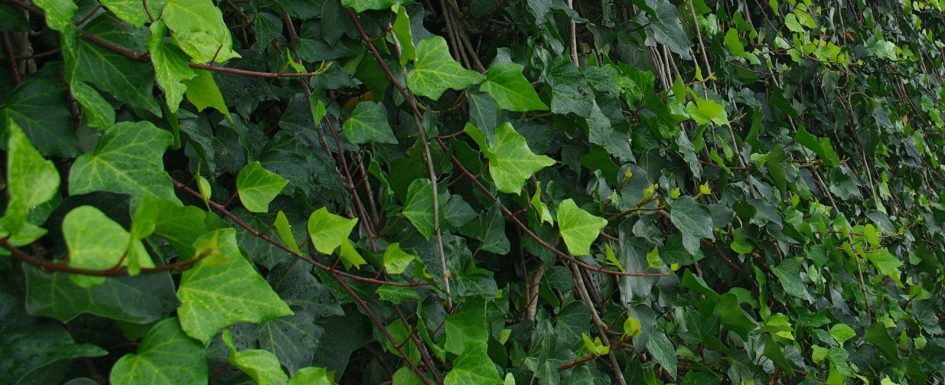
A living wall, preserved foliage, and an artificial plant panel may produce a related visual impression, but they are fundamentally different systems. Choose among them by the room’s light, humidity, use, and realistic maintenance capacity before considering how much wall to cover.
In this project-based account, Clara AJMAR treats planting as part of the interior composition, not as a decorative purchase independent of the building. The opening photograph shows a dense living façade outdoors. Indoors, that image is inspiration rather than proof that the same plants will flourish in a dim passage.
Living plants require a horticultural and building strategy
Assess daylight through the day, not just during a bright viewing. A conventional household bulb does not automatically supply adequate growing light. The original article strongly discourages living systems in north-facing, poorly exposed, or windowless rooms after seeing installations deteriorate within three months.
That warning should not be confused with the claim that plants can never grow under artificial light. Properly specified horticultural lighting can support them, but it adds design, energy, and maintenance requirements. For an ordinary domestic brief without such a system, a dark corridor or windowless restroom is a strong reason to consider another solution.
A living wall is technical equipment as well as planting: a watertight backing, felt pockets or substrate-filled modules, drip irrigation, and a collection tray at the base. When wet it can weigh several dozen kilograms per m². Verify the supporting wall or frame, anchorage, and the complete installed load before specifying it.
The source also calls for separation and moisture protection between the installation and the building wall. Plan an accessible water supply, drainage or reservoir, and power for the pump. A closed-loop irrigation system can help manage watering, but automation does not eliminate inspection, plant replacement, or the risk of a fault.
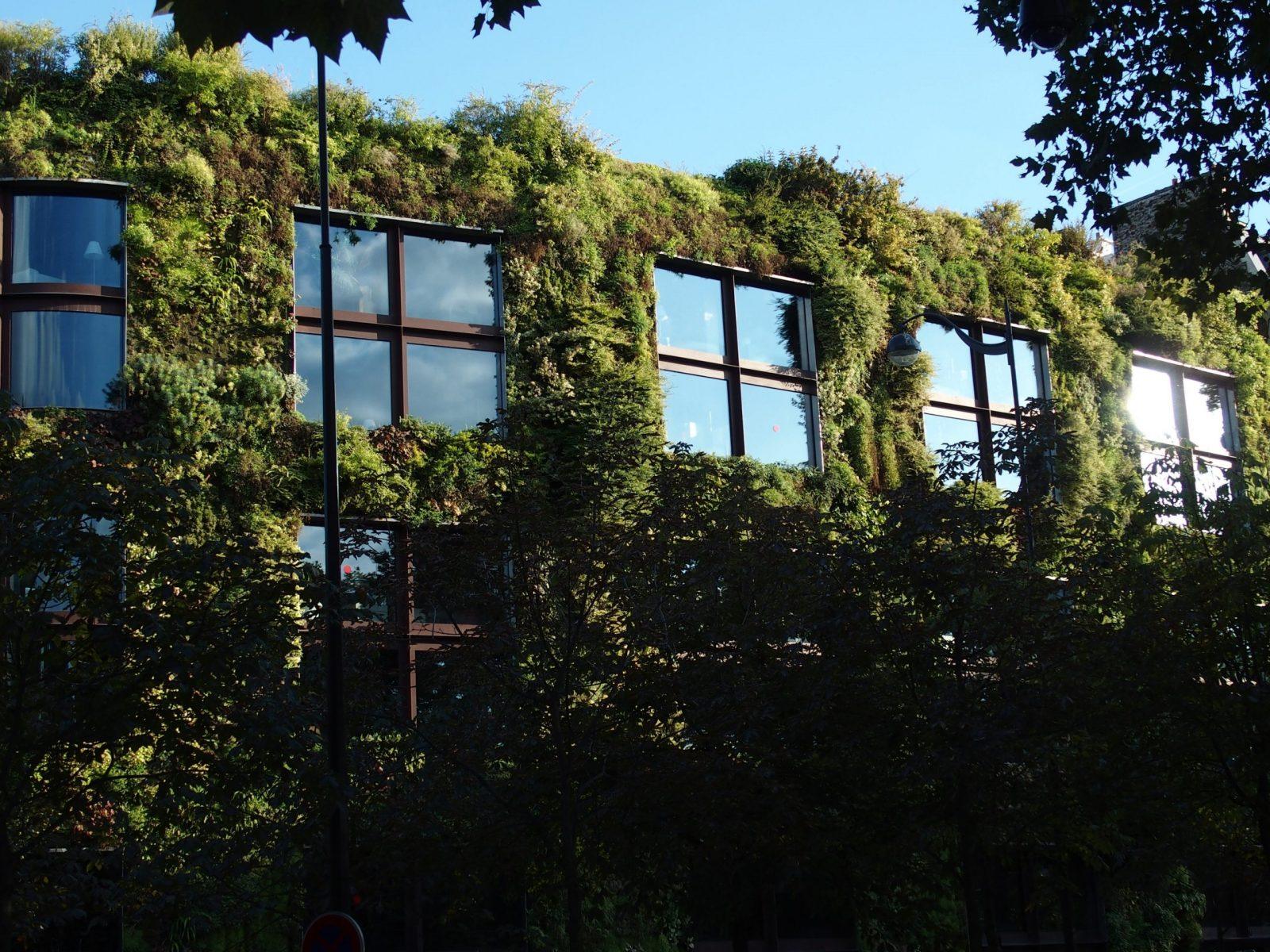
Living plants need ongoing care appropriate to their species. The question is not whether the first-day result looks exceptional, but who will maintain the system, reach it safely, and notice a problem. If either light provision or maintenance remains uncertain, preserved or good-quality artificial planting may fit the brief more honestly.
Preserved plants are natural material, but no longer living
Preserved foliage has undergone a conservation process to retain a natural appearance. It does not need watering or growing light and usually requires only occasional gentle dusting. Moss, cushion forms, lichen, foliage, and mixed compositions offer different textures and densities.
The absence of irrigation does not mean the product can go anywhere. Direct sun may fade it; nearby heat can damage it; persistent high humidity may soften it or cause seepage. A moderate indoor environment, neither extremely dry nor saturated, is generally more suitable. Follow the supplier’s actual environmental limits.
Compare the plant type, density, support quality, frame, and fixing method. A small framed composition, modular panels, and larger strips or sections have different installation implications. Lighter than a wet living system is not the same as weightless: the wall and fixings still need to support the selected product safely.
A preserved composition is therefore not a default choice for a steamy bathroom. In a well-ventilated room, a supplier-approved location away from shower spray may be possible. Otherwise, an appropriate artificial panel or wet-area-suitable botanical wall treatment may be more dependable.
Artificial planting and botanical wallpaper offer another kind of freedom
Well-made artificial foliage can provide a convincing visual texture without irrigation or horticultural light. Look at leaf density, variety, stems, color, and the visible panel background. A smaller high-quality composition may look better than a large area of repetitive, thin foliage.
Near a window, check UV resistance so the intended green does not quickly fade. In a waiting room, shop, or other public-access setting, obtain the reaction-to-fire documentation required by the applicable rules. A realistic appearance is not evidence of acceptable fire performance.
Panels may clip together and attach to battens or another lightweight support. Unlike a living system, they do not require an irrigation waterproofing assembly, though safe anchorage and any relevant wall requirements still apply. They also need dust removal and inspection even if no plant care is involved.
Botanical or tropical wallpaper is a distinct alternative. It can establish a plant reference without the depth of a full planted panel, which may be useful in a compact room. Selected artificial trailing stems arranged by hand can add relief in one place rather than covering every surface.
See our projects in video
Real floor plans and renovations explained step by step on the ArchiWorking YouTube channel. Watch how spaces are reworked before the works begin.
Keep the original budget figures in perspective
The French source records preserved-wall references of 300 to 550 EUR per m², with a typical middle range around 400 to 450 EUR per m². For 4 m², it illustrates a budget around 1,600 to 1,800 EUR. These are historical project-context figures, not current ArchiWorking service prices or an offer.
Note: prices are indicative, based on projects in France in 2017, and vary by project, region and finish.
For artificial panels, the source gives 60 to 75 EUR per m², or approximately 250 to 300 EUR for the same 4 m². Quality and density influence the visual result strongly. Reducing coverage while choosing better material can be a more coherent decision than filling a large wall with a poor imitation.
The article describes these references as covering the planting and its installation. A living wall additionally brings backing protection, water connections, drainage, pump equipment, and commonly an annual maintenance arrangement for pruning, replacement, and irrigation checks. Lighting provision may be another separate item.
To compare proposals, ask for the exact area, type of planting, fixing system, and included support, lighting, and maintenance. A price per square meter is not meaningful if the installed scope differs. No current quotation can be inferred from the illustrative ranges alone.
A short-stay rental: a botanical atmosphere without irrigation
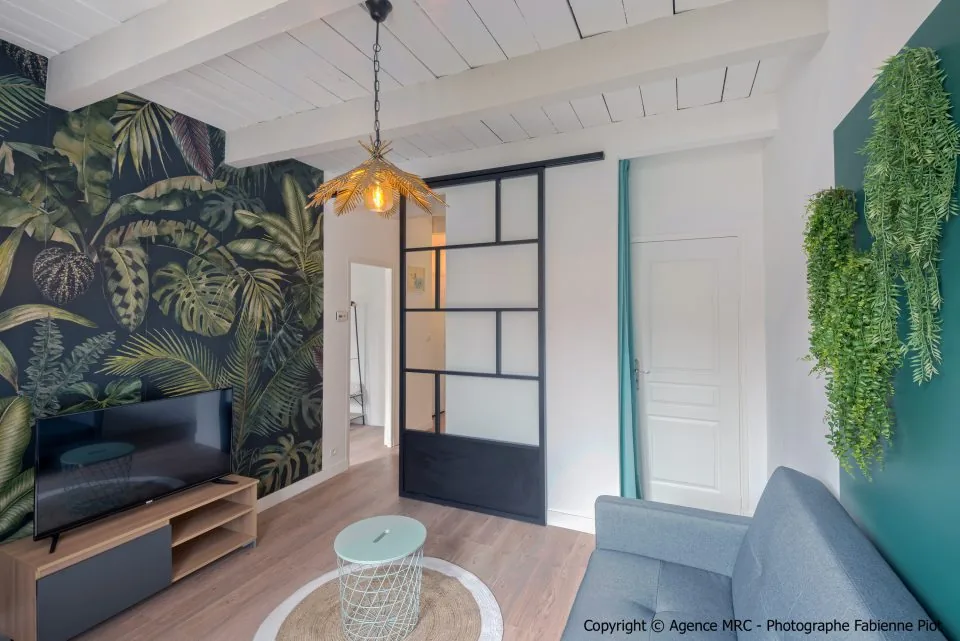
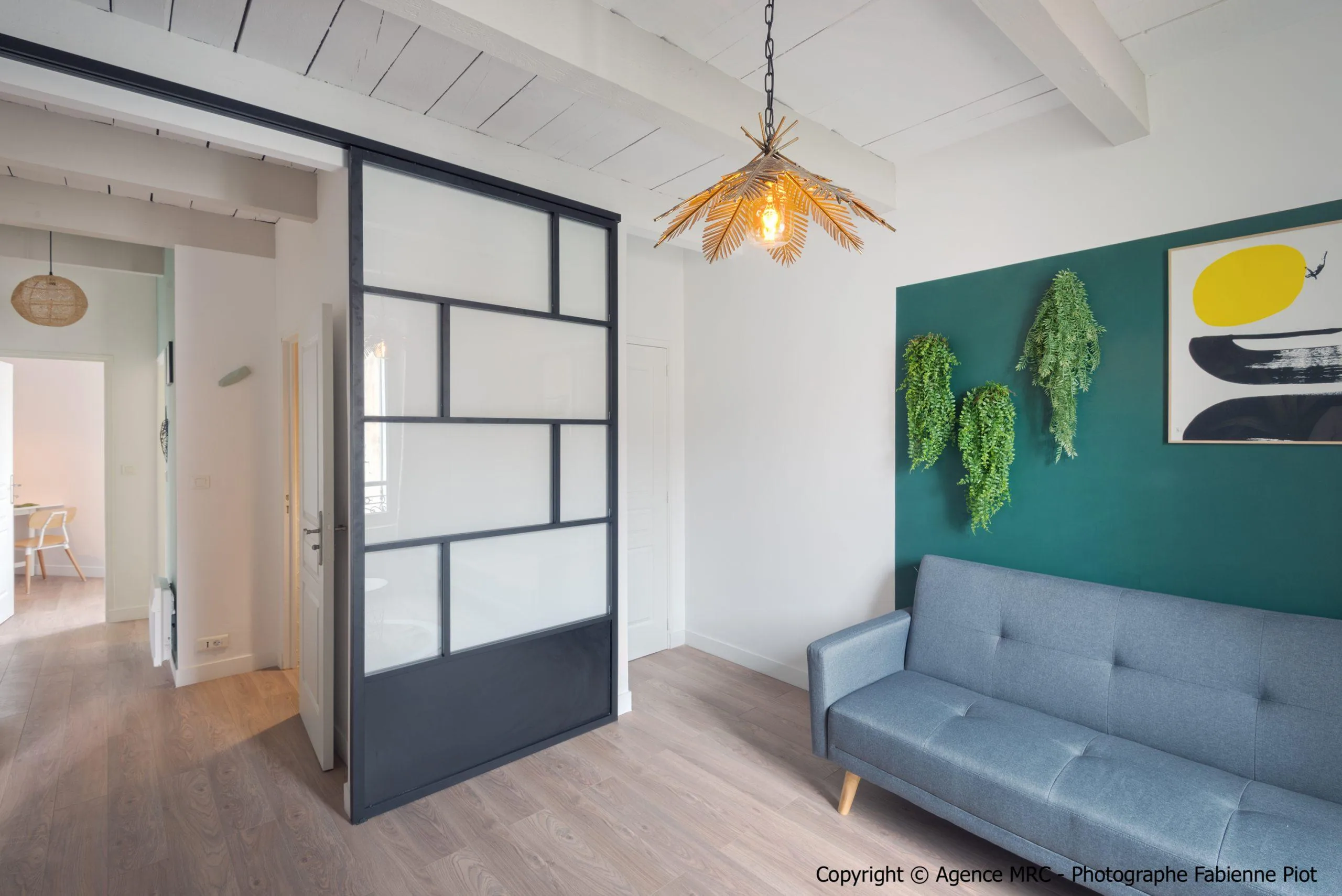
One apartment project needed a strong atmosphere with controlled expenditure and no ongoing horticultural work between guests. The design used two complementary registers: dense tropical wallpaper on one wall and artificial trailing foliage on a teal-painted surface.
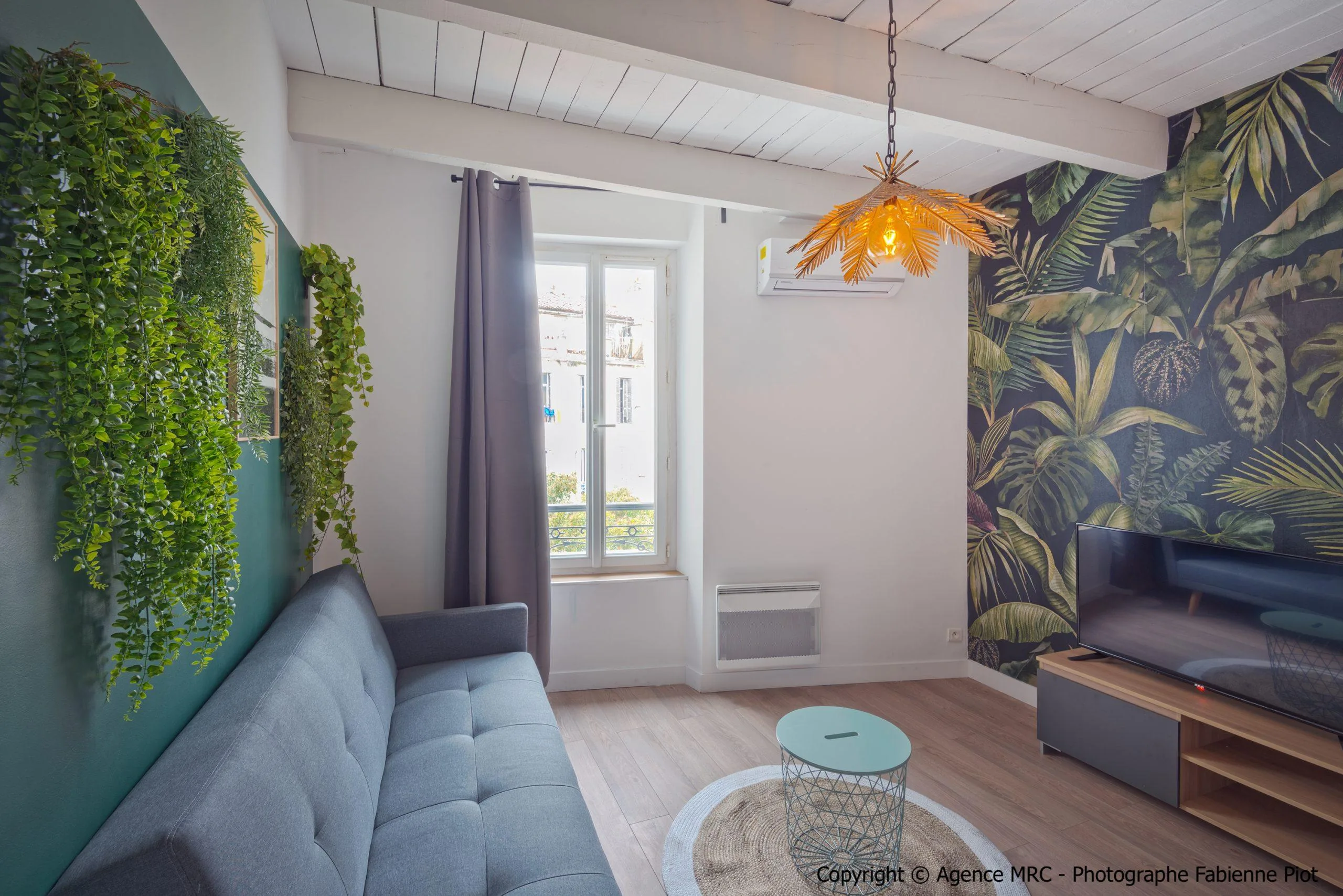
The photographs show how the elements relate to black-framed glazing, natural-fiber pendant lighting, a gray-blue sofa, and a colorful picture. Another view looks back from the window toward the television unit against tropical wallpaper. The plants are not intended to convince a gardener that a new ecosystem has been installed; they provide a coherent interior atmosphere.
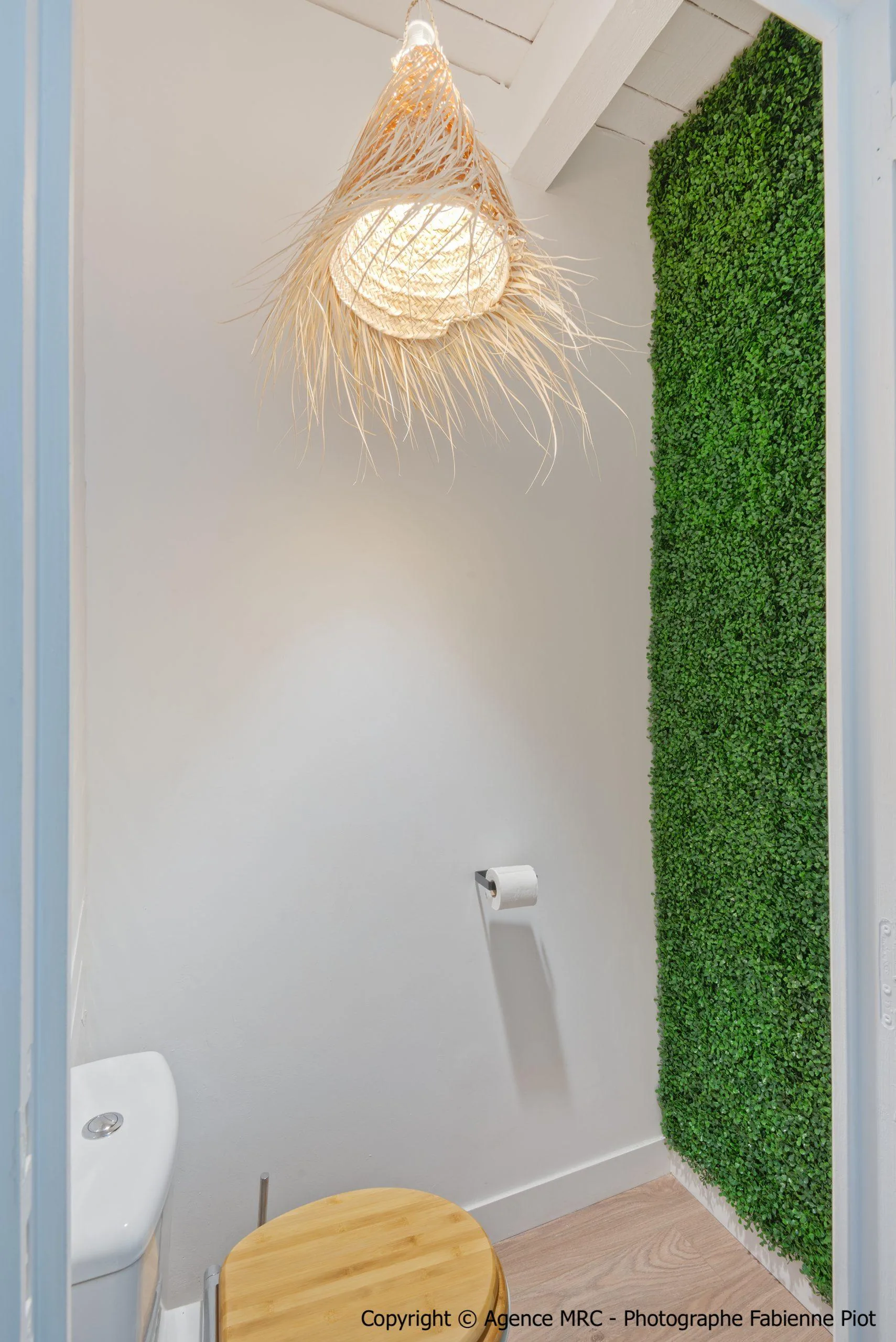
In the windowless restroom, a full-height vertical artificial panel occupied one corner. In a space typically around 1 m² in the source’s example, that narrow column created a surprising focal point. A living installation without appropriate growing light and servicing would have added constraints out of proportion to this brief. See storage ideas for a small restroom for another part of making that limited area useful.
Combining wallpaper with a few good artificial elements is also one of the author’s methods for a tighter budget. It distributes the visual reference without requiring every wall to carry a costly full planted system.
A dental waiting room: suggest an opening toward a garden
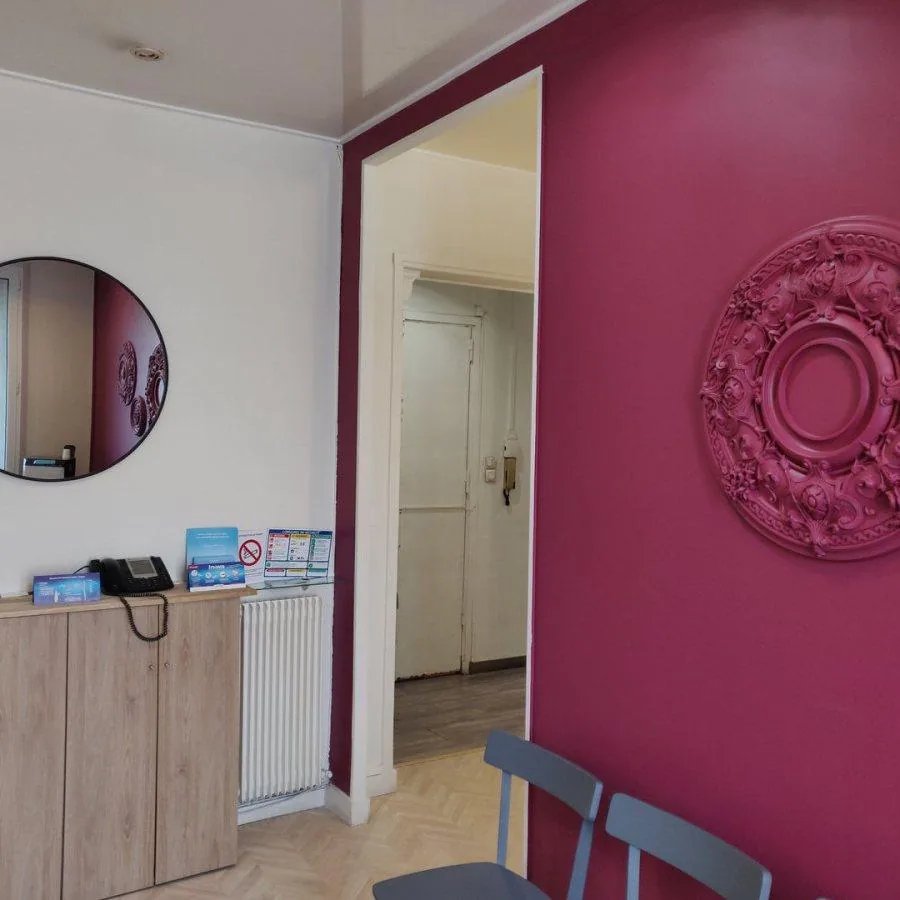
During the renovation of a dental practice in an older apartment, the owners wanted a more welcoming waiting room. A high-level framed composition of preserved or artificial foliage was proposed as a suggestion of an opening onto a garden.
It belonged within a larger setting of mouse-gray and wine-colored walls, molding, herringbone parquet, and a round mirror. The photograph shows that composition, including a molded ceiling rose and a low timber cabinet. It documents the room’s material context, not proof of a particular installed living-wall system.
A decorative panel suited the use better than a living wall that would add watering, specialist lighting, and plant-care requirements. The decision was about the actual operation of a waiting room. See planning a waiting room for the wider design considerations.
Match the plant reference to the room
For real potted plants in a suitably lit room, choosing and placing an indoor plant may offer a more manageable route than a complete wall. Our indoor winter-garden article explores a larger planted setting. The relationship between indoor and outdoor vegetation also matters in a pool project, but a visual connection does not mean the same system belongs on both sides of the glazing.
The final choice should follow the room’s light, use, humidity, and accepted maintenance. Budget matters, but cannot make an unsuitable living system appropriate. Preserved material, artificial foliage, or a botanical surface can be the more coherent result when they meet those real constraints.
Common questions
Is a living wall possible without a window?
Only with a properly designed alternative light and servicing strategy. A normal decorative bulb is not enough by assumption. For the low-maintenance domestic situations in this article, preserved or artificial planting is usually the more suitable choice.
Does preserved foliage need watering?
No. It is conserved material rather than a growing plant. Keep it within the supplier’s humidity and temperature limits, out of damaging direct sun, and dust gently as instructed.
Does artificial foliage need no care at all?
It avoids horticultural maintenance, not cleaning or safety checks. Remove dust appropriately, verify the fixings, and choose UV and fire characteristics suited to the location.